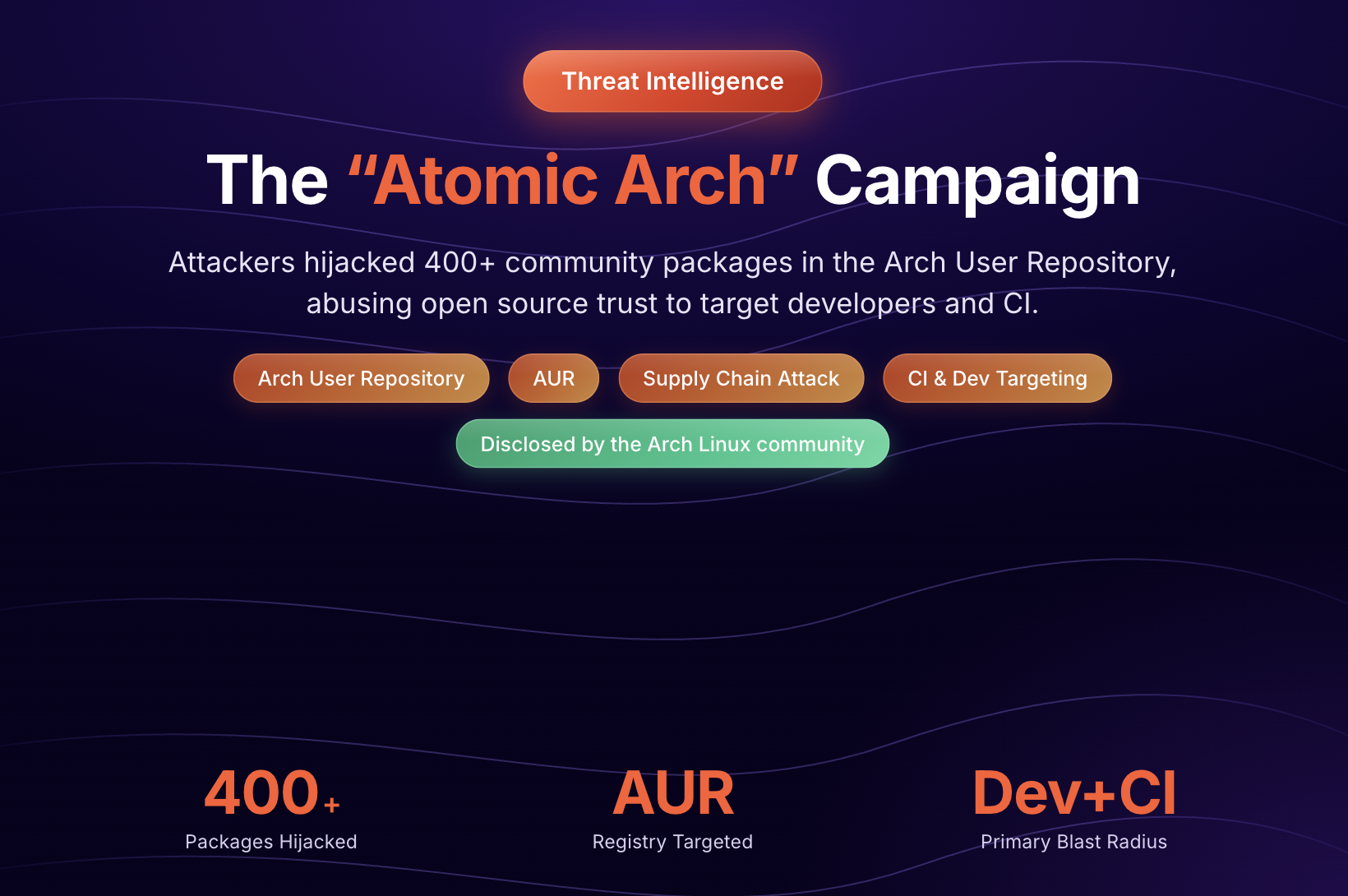
On June 11th 2026, security researchers and the Arch Linux community disclosed a large-scale supply-chain attack against the Arch User Repository (AUR). Attackers hijacked more than 400 community packages and turned them into a malware delivery network. While the immediate blast radius is limited to Arch Linux systems, the campaign is a textbook example of how modern attackers compromise developers and CI infrastructure by abusing trust in open-source ecosystems.
This post breaks down what happened, how the malware works, and what it means for teams running CI/CD and self-hosted runners, and for developer machines running MacOS/ Windows/ Linux.
What Is the Arch User Repository (AUR)?
The AUR is a community-driven repository where Arch Linux users share build scripts (PKGBUILDs) for software not in the official repositories. Users or AUR helpers clone these PKGBUILDs and build native packages locally, which means any malicious logic in those scripts executes directly on the developer’s machine as part of the build or install process.
A key feature of AUR is ownership transfer: if a maintainer abandons a package, another user can request to adopt it, inheriting the package name and its reputation. This mechanism keeps useful software alive, but it also creates a powerful avenue for attackers to quietly take over trusted packages.
The “Atomic Arch” Supply-Chain Campaign
Sonatype researchers dubbed theJune 2026 incident “Atomic Arch,” after discovering that attackers had systematically adopted orphaned AUR packages and injected malicious build logic. Follow-up community analysis showed the scale was far larger than initially reported: more than 400 packages had been modified to execute attacker-controlled code.
The attack pattern was deceptively simple:
1. Adopt orphaned packages. Attackers targeted packages with existing users and a history of legitimate use.
2. Inject a malicious dependency. They modified the PKGBUILD or install hooks to run npm install atomic-lockfile (and variants like js-digest), pulling in a malicious Node package.
3. Silent execution. When users installed or updated the AUR package, it transparently fetched and executed the malicious dependency.
These weren’t obviously suspicious packages. They were ordinary tools that had built up trust over time, quietly converted into a malware distribution channel by a single added dependency.
What the Malware Actually Does
The malicious npm package masquerading as atomic-lockfile contains a credential-stealing payload written in Rust, with optional rootkit-like capabilities on systems where it gains root.
The stealer targets high-value assets on developer and CI hosts:
• Browser cookies and session tokens (for SSO, cloud consoles, SaaS apps)
• SSH keys and known_hosts
• GitHub, npm, and other developer tokens
• Slack, Discord, and Teams sessions
• Docker/Podman credentials and cloud access keys
On systems where it runs with elevated privileges, the malware can also attempt eBPF-based persistence to hide processes and file activity, making detection and cleanup significantly harder. A compromised host should be treated as fully untrusted: rebuild from clean media and rotate all exposed credentials. A one-off malware scan is not sufficient.
Who Is Affected and Who Isn't
The AUR is an Arch Linux–specific ecosystem.
Directly affected:
- Arch Linux and Arch-based distributions (EndeavourOS, Manjaro when AUR is used) where users install AUR packages.
- Self-hosted CI runners or build agents running Arch that install AUR packages in their bootstrap or job steps.
- Windows developers running Arch under WSL2 and installing AUR packages inside that environment - a common setup among developers who want a Linux toolchain on Windows.
Not directly affected by this vector:
- GitHub-hosted runners (Ubuntu, Windows, macOS images), which do not use AUR.
- Self-hosted runners on RHEL/Rocky, Debian/Ubuntu, or Windows, unless they pull in Arch/AUR through nested virtualization or similar setups.
- macOS and Windows developer machines though macOS faces structurally similar risks through Homebrew, which has the same package ownership-transfer model. A hijacking campaign targeting abandoned Homebrew formulae or third-party taps would hit macOS developer machines in exactly the same way.
However, the targets of the malware - developer credentials,GitHub tokens, cloud keys - are the same assets that drive CI/CD pipelines and access production environments everywhere. An attacker who compromises a single Arch-based developer laptop can still pivot into GitHub, npm, or cloud accounts that power non-Arch production systems.
Why This Matters Beyond the Arch Community
The Atomic Arch campaign has broader implications for any team thinking seriously about supply-chain security.
Ownership hijacking beats typosquatting. Instead of publishing lookalike packages, the attackers targeted abandoned but trusted packages, inheriting users and reputation in one move. The same pattern is increasingly visible in npm, PyPI, and GitHubActions, where maintainers are socially engineered or inactive projects are quietly taken over.
Build scripts are an execution environment. PKGBUILDs, postinstall hooks, GitHub Actions workflows, and Dockerfiles all run with powerful privileges but are often reviewed casually, if at all. Atomic Arch is another reminder that install-time logic is a first-class attack surface.
The payload is tuned for developers and CI. The malware doesn’t go after random consumer data. It goes after keys, tokens, and sessions that unlock entire organizations. This aligns with other recent campaigns where compromised npm packages or GitHubActions exfiltrated CI secrets at massive scale.
Even if you never touch Arch, this incident is another data point showing where attackers are aiming and how little code they need to change to reach your pipeline.
Immediate Response: What to Do Now
If your organization uses Arch for any developer workstations or self-hosted runners, treat this as an incident-response moment, not just interesting news.
1. Identify potentially affected hosts. Enumerate Arch and Arch-derivative systems in your environment (laptops, lab machines, self-hosted CI runners). Review AUR install and upgrade history since early June 2026, and cross-check against known-bad package lists.
2. Assume credential exposure if a bad package ran. RotateSSH keys, GitHub tokens, npm tokens, cloud API keys, Vault tokens, and anyother secrets stored or used on affected machines. Invalidate browser sessionsand regenerate passkeys where possible, especially for admin and SSO accounts.
3. Rebuild highly trusted systems. For any host where the malicious payload may have run as root, treat it as compromised. Rebuild from trusted media. Rejoin it to your CI or infrastructure only after reinstallation and re-provisioning with fresh credentials.
4. Add behavioral monitoring. Monitor build hosts and runners for unexpected package manager calls, network egress during build steps, and creation of suspicious systemd units or eBPF objects. Watch for anomalous outbound connections to paste sites, file-sharing services, or Tor.
How StepSecurity Can Help
At StepSecurity, we build tooling specifically designed to catch this class of threat where it matters most on both your CI pipelines and developer machines.
Harden-Runner monitors GitHub Actions, GitLab CI, and Azure DevOps pipeline steps at runtime, detecting unexpected network egress, unauthorized process spawning, and anomalous package manager activity -exactly the behaviors the Atomic Arch malware exhibits when it runs on a build host.
Dev Machine Guard addresses the other half of the attack surface: the developer workstation. Since Atomic Arch targets laptops and local environments first, stealing SSH keys, GitHub tokens, and browser sessions before pivoting to production, Dev Machine Guard provides visibility on developer machines, alerting on suspicious activity the moment it happens.
Supply-chain attacks are not going to slow down. The best defense is visibility into what your build environment and developer machines are actually doing, and the ability to detect the unexpected before secrets leave the device.