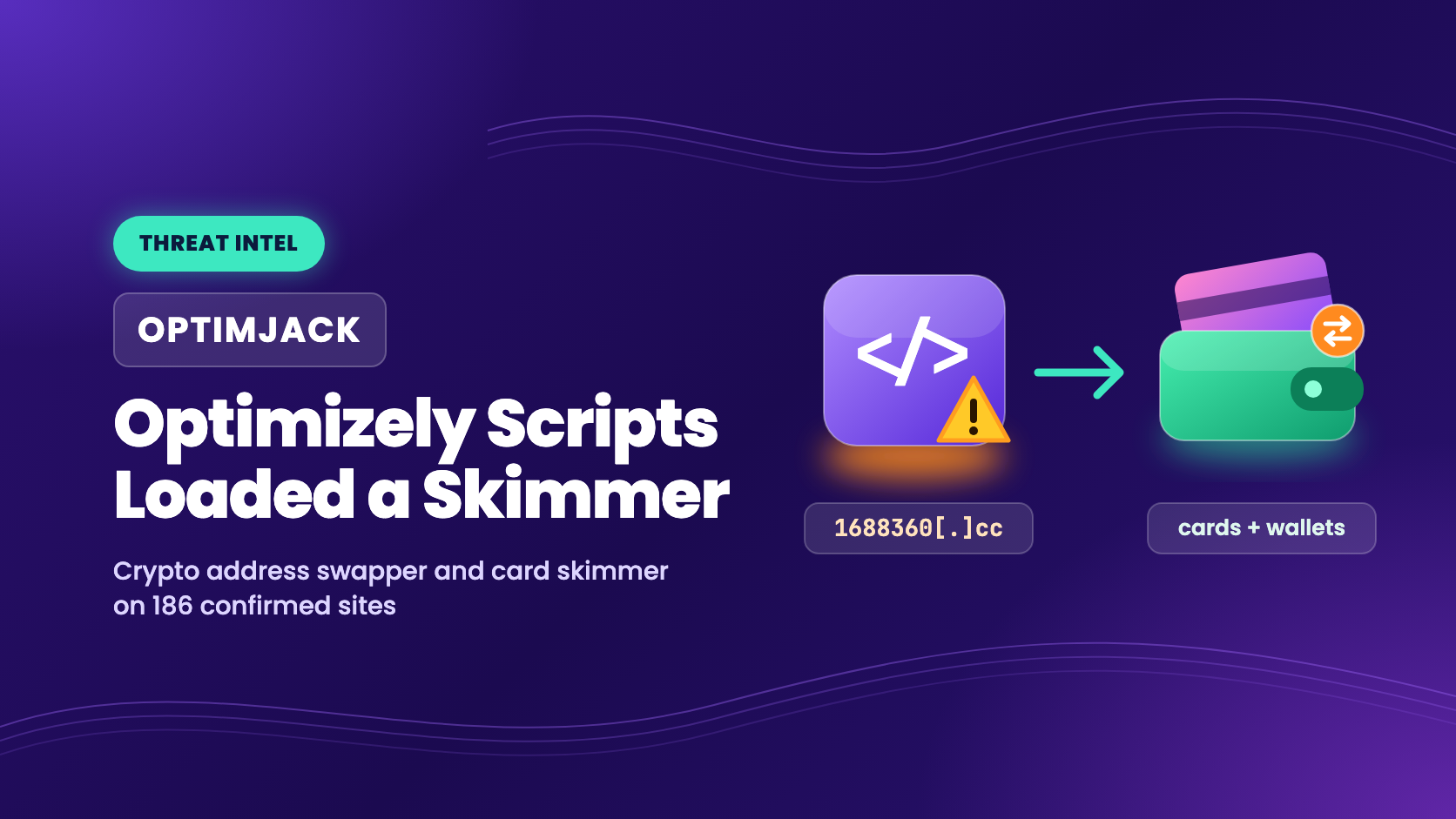
On November 16, 2026, urlscan.io captured the same payload being served from 1688360[.]cc to pages on CNN, BBC, Fox News, Zoom, Salesforce, GitLab, KLM and ten other sites. The payload swaps copied crypto wallet addresses, steals card numbers from checkout forms, and on iPhones and iPads loads a second stage from .icu domains.
Security researcher Scott Helme counted 186 infected sites and 188 infected script files and described the source as a breach of a third-party JavaScript host. A write-up by Amirul Cyber named the campaign OPTIMJACK and traced twelve of its fifteen example pages to scripts served from cdn.optimizely.com. We confirmed that chain on a GitLab page. Optimizely has not published a statement that we could find.
The loader is one line. It adds a script tag for https://1688360[.]cc/track.js, so the attacker's code runs with the same access as the site's own JavaScript.
We checked the public scan records, DNS and WHOIS, the live payload and the attacker's wallets, and found three things that the public write-ups we read do not cover:
- The operator edited the payload at least four times in two hours. It grew from 28,877 to 30,430 bytes, and the final version went live at 17:56 UTC.
- The iOS infrastructure predates this campaign. Two of the iOS-stage domains were registered on November 9, and one was serving a page by November 12.
- The take so far is about $6,600. Four of the eight attacker wallets have never received anything. Stolen cards, cookies and iOS access do not show on-chain.
Action required: Block 1688360[.]cc and the .icu hosts in the IOC table. If your site loads an Optimizely snippet, fetch it from cdn.optimizely.com and search it for 1688360. Optimizely was cleaning files on the evening of November 16, so a clean result now does not show the file was clean earlier.
Who Was Affected
Helme has not published his list of 186 sites. Public urlscan.io data lets us name some of them.
Between 08:28 and 21:23 UTC, 76 scans of third-party pages, across 30 domains, recorded a request to 1688360[.]cc. For 17 of those domains, urlscan stored the payload itself: the exact file with SHA-256 f7b84b9a…, served with HTTP 200 to a page on the site between 17:57 and 21:23 UTC. They are:
- News: CNN, BBC and Fox News.
- Software: Zoom, Salesforce, GitLab, Hootsuite and Smartsheet.
- Airlines and retail: Air France, KLM, American Eagle, American Girl, Scheels and Stamps.com.
- Insurance and housing: Mutual of Omaha and two property-management portals (
loftliving.comandmanagebuilding.com).
The other 13 domains also recorded a request, but urlscan has no stored copy of what they were served, mostly because the scans were taken before the final version went live at 17:56 UTC. They include Virgin Media O2, Tricentis, HSBC Singapore Insurance, UNICEF USA, Change.org, IG, TSN and Bitly. On Optimizely's own site, www.optimizely.com, the request failed.
Amirul Cyber's write-up lists 15 example pages and reports how the payload reached some of them: twelve through Optimizely-hosted scripts, Fox News through an ad script, American Eagle through its own bundle and Air France through a protected third-party script. We confirmed the loader chain on two pages. On a GitLab page, a consent manager (cdn.cookielaw.org) loads cdn.optimizely.com/js/5113954737848320.js, and that file loads 1688360[.]cc. On a Mutual of Omaha page, cdn.optimizely.com/js/25010540072.js requests track.js directly.
How the Attack Works
Optimizely Web serves each customer's experiment code as a script from cdn.optimizely.com, usually at /js/<project ID>.js. A site includes it with one script tag, and the code runs in the page, so whoever controls the file controls what every visitor's browser executes.
The earliest public scan that recorded a request to the payload server was at 08:28 UTC, about three hours after the domain was registered. At about 21:32 UTC, Helme reported that the provider was cleaning files and that 41 of the 188 infected files were still infected. That is an exposure window of at least 13 hours. GitLab's bundle was clean when we fetched it afterward, but the payload server was still live, so any file not yet cleaned still runs it.
The payload is one JavaScript file of about 30 KB with three independent blocks and an iOS branch. We read it as text and did not run it.
Crypto address swapper
The script holds replacement addresses for ETH, TRX, BTC, TON, SOL, LTC, BCH and DOGE. It only swaps an address that passes the chain's checksum, so the replacement is valid and the victim's wallet will accept it, and only when nearby text contains a payment word such as wallet, deposit or send.
It rewrites addresses in page text, form inputs, link and image attributes, copy events, the clipboard API, navigator.share, and the URL and body of fetch and XHR requests. It also replaces Function.prototype.call and apply, so a string that looks like a wallet address is rewritten before it reaches any function.
Because it hooks the copy event, an address copied from an affected page can already be swapped when you paste it into a wallet app. Check the address on your wallet or hardware-wallet screen against the one you meant to use, not against what you copied.
Screenshot and cookie exfiltration
After the first swap on a visible element, the script loads html2canvas.min.js from the payload server, captures the visible page as a JPEG, and POSTs it to /hit.php with the page URL, up to 8,000 characters of document.cookie and up to 20 of the original addresses. This happens once per page load and only after a swap, so a visitor who never handles a wallet address does not send cookies. HttpOnly cookies are out of its reach.
Card skimmer
A second block wraps fetch and XHR and listens for form submits. It looks for a card number that passes the Luhn check and has a known brand prefix, a valid expiry date and a three- or four-digit CVV, and sends them with the page URL to /card.php using navigator.sendBeacon. It does not collect the cardholder name or billing address, and it cannot read card fields inside a cross-origin payment iframe. It also stores each captured card in sessionStorage under a key that starts with cc_ so it does not send the same card twice, which leaves card data in the victim's browser storage.
iOS second stage
If the user agent is an iPhone, iPad or iPod, the script adds two boot.js scripts from .icu hosts. On iOS 18.6 or earlier it also adds a hidden iframe that loads /JIUJIU888/weifile.html. Helme says the malware includes DarkSword or Coruna iOS exploits. We did not retrieve or analyze these files, so we cannot confirm which exploit chain runs or against which versions.
What We Found
The payload changed four times in two hours
urlscan's records of track.js show its decoded size growing from 28,877 bytes at 16:02 UTC to 29,461 at 16:19, 29,871 at 17:34 and 30,430 at 18:11, where it stayed. The final version went live at 17:56 UTC. The server sends cache-control: max-age=15, so the operator can swap the file within seconds. The final version references an iOS-stage domain registered at 16:38 UTC, so part of the iOS branch was added mid-incident.
The hash in Amirul Cyber's write-up (f7b84b9a…) is the final version, and its Last-Modified header reads 17:56:07 UTC. urlscan's first capture (617df364…) is a different file. Match on behavior and domains, not on one hash.
The iOS infrastructure predates this campaign
The .icu domains were registered in three batches:
l7bcsnwc7nzr3uo[.]icuon October 28, behind Cloudflare.5vobauua3ojpklx[.]icuandp55abnw2pnsz0bo[.]icuon November 9 at 17:52:42 UTC. Both resolve to34.96.213.201in Hong Kong.eil786npto9u5bq[.]icu,1y69gy2mdzaltz1[.]icuandgm38duxoihbmy5o[.]icuon November 16 at 16:38:42 UTC. All three resolve to34.87.36.58in Singapore.
Three domains created in the same second and hosted on one IP address are one operator's batch. Public scans show 5vobauua3ojpklx[.]icu serving /A8/a.html on November 12, four days before this campaign. The domain q1ls1ho9x7wsxlu[.]icu, which Helme listed, does not exist in DNS or WHOIS as of 22:07 UTC.
The payload server 1688360[.]cc was registered at 05:23:08 UTC on November 16 and points at 136.113.106.136, a Google Cloud address in us-central1. Shodan's last record of that address before the campaign, from November 5, shows only SSH.
The wallets hold about $6,600
We checked the attacker's addresses on public block explorers. At November 16 prices, the BTC, LTC, ETH and TRX addresses have received or hold about $6,600 combined, close to the roughly $7,000 Helme reported.
Balances from BlockCypher and Trongrid, prices from CoinGecko, all checked on November 16. USD values use those prices, not the price at the time of each transfer. The TRC-20 balance is the standard USDT contract on TRON.
The ETH and TRX addresses were active before November 16, so some of what they hold may not come from this campaign, and the chain does not show which transfers came from victims. One transaction accounts for most of the Bitcoin.
Why the Usual Defenses Miss It
- The site's own code is clean. The change is in a vendor-hosted file, so code review and repository scanning never see it.
- A consent banner does not help. In the GitLab scan the consent manager is what loads the Optimizely bundle. It controls when the script runs, not what the script contains.
- Subresource Integrity is hard to apply. A snippet that changes whenever a team publishes an experiment cannot be pinned to one hash.
- Content-Security-Policy helps, with one exception. A host allowlist in
script-srcblocks the download oftrack.js, and aconnect-srcallowlist blocks the exfiltration. A policy that usesstrict-dynamicwith a nonce does not, because it trusts scripts that a trusted script adds. The write-up reports that two affected sites blocked the payload this way. We could not verify that, though the request fromwww.optimizely.comdid fail.
What To Do Now
- Block the indicators. Add
1688360[.]ccand the.icuhosts to your DNS and proxy blocklists, and search logs back to 08:00 UTC on November 16. - Check your Optimizely snippets. Fetch every snippet you serve from
cdn.optimizely.comand search it for1688360,.icuandtrack.js. Record the Last-Modified header. Ask Optimizely which project IDs were modified, when, and how. - Look for blocked requests. Check CSP reports and browser telemetry for failed requests to the payload server. Those are pages where the loader was present.
- Protect payment pages. Remove third-party tags from checkout where you can, and use the payment provider's hosted fields in a cross-origin iframe, which this skimmer cannot read.
- Treat exposed cards and wallets as compromised. If staff or customers entered card details or copied a wallet address on an affected site during the window, replace the card and verify wallet addresses on a hardware-wallet screen.
- Update iOS devices. Treat iPhones and iPads on iOS 18.6 or earlier that visited affected sites as candidates for forensic triage.
We have not established how the Optimizely-hosted files were modified, who is behind the campaign, or what the iOS stage delivers, and Optimizely had published no statement as of 21:44 UTC on November 16. We will update this post as those points are confirmed.
Indicators of Compromise
Sources are marked in each row. “Our analysis” means the payload review, DNS and WHOIS checks and wallet checks described above, as of November 16.
References
- Scott Helme on X: thread on the breach of a third-party JavaScript host
- Amirul Cyber: OPTIMJACK write-up
- urlscan.io: scan of
1688360[.]cc/track.jsand scan of a GitLab page - Reddit r/cybersecurity: first report of the script on gitlab.com and foxnews.com