Ashish and I still remember the incident-response war rooms after the SolarWinds supply chain attack in Dec 2020. Ashish was at Uber and I was at Microsoft. We were trying to answer two questions: were we affected and how would we prevent an attack like this from happening again? The cybersecurity solutions we had relied on offered frustratingly little help with the questions in front of us. Our teams scrambled to piece together the answers and build homegrown workarounds under high pressure.
A few months later, attackers inserted malicious code into Codecov’s Bash Uploader, bringing the same scramble back. The malicious code stole secrets from customers’ CI/CD environments for roughly two months before it was discovered.
The security tools we relied on focused on vulnerabilities attackers might exploit in production. These attacks exposed a different risk. Malicious code could cause damage on a developer’s machine or in a CI/CD pipeline. It did not need to reach production.
Those experiences drove us to start StepSecurity in 2021. We wanted security teams to have visibility and protection in the environments where software gets built.
We raised our seed round of $3 million in May 2024. Since then, our ARR grew 5× in 2024 and again in 2025. In 2026, we have already crossed that 5× growth milestone and are on pace for our biggest growth year yet.
More than 20,000 open-source projects now use our Harden-Runner community tier. Enterprise customers including Circle, Dexcom, Kong, Mercor, Mercari, Chainguard, and XBOW trust StepSecurity to protect their software supply chains.
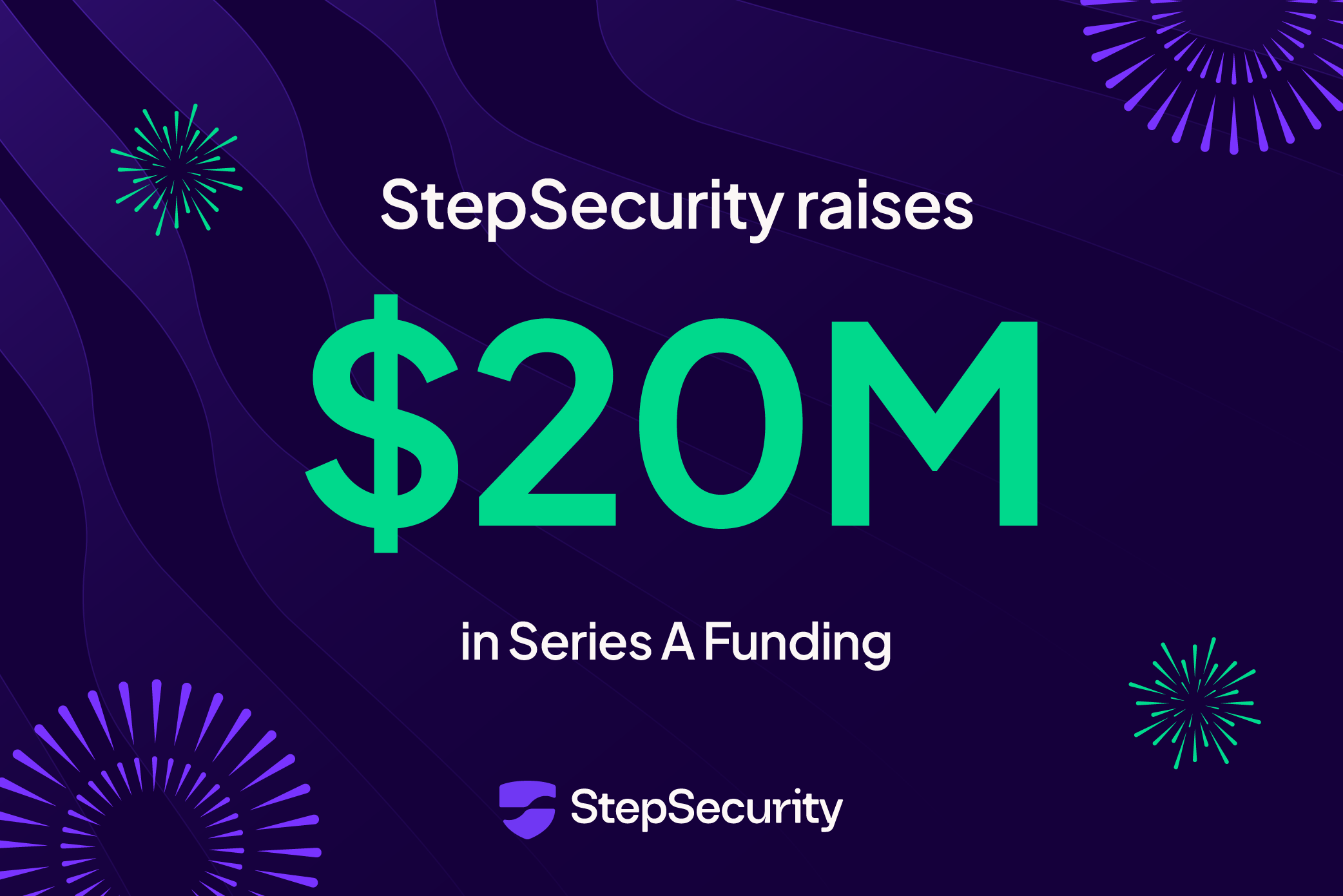
Today, we’re announcing an oversubscribed $20 million Series A led by Elephant, with participation from existing investors Runtime Ventures, Inner Loop Capital, and SaaS Ventures.
The problem that led us to start StepSecurity has grown more urgent and now extends to every knowledge worker. Any knowledge worker can ask an AI agent to perform a task, such as creating a spreadsheet. To complete it, the agent may download open-source packages and execute code.
Software is now built everywhere: by agents on laptops, in the cloud, and inside pipelines. That creates a larger attack surface, even as AI makes attacks easier to launch.
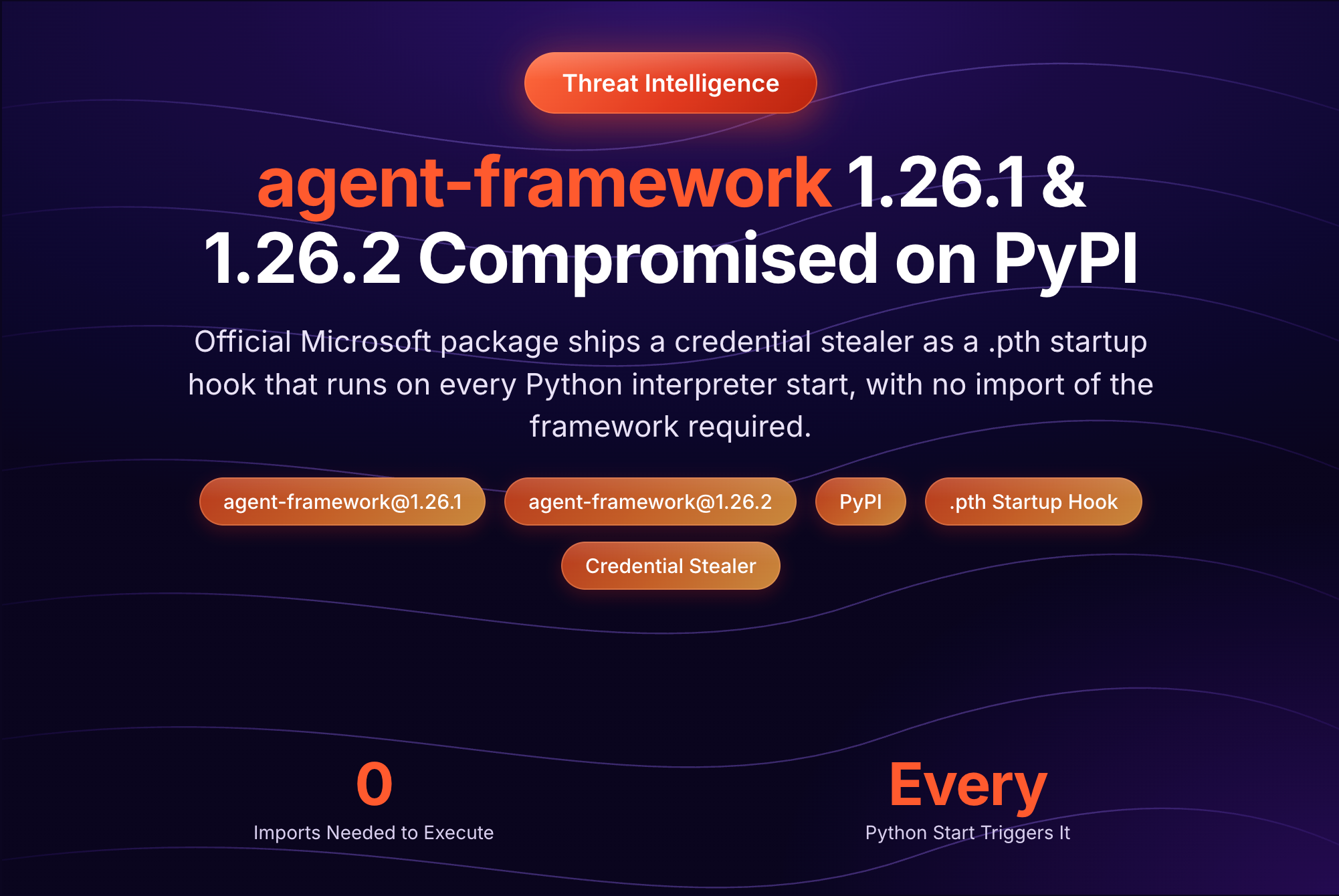
Recent attacks show how developer tools and workstations can expose sensitive systems. Examples include the tampered Claude Code extension in Cursor’s marketplace and Binance’s reported breach.
This funding will strengthen the protection our products provide for developer machines, package downloads, and CI/CD. It will also help us build protection for agent sandboxes.
The problem that brought us here
Ashish and I met at Microsoft in 2009. I went on to lead the Green Team within Azure Security, focused on making security easy for developers. Ashish built Uber’s cloud security function and later led infrastructure security at Plaid, securing cloud environments and the systems developers used to build and deliver software. We had lived with the challenge of protecting those environments while helping developers get their work done.
We saw attackers shifting left into the systems used to build and deliver software by compromising trusted open-source components that many enterprises used. From their perspective, it made sense: compromise one component, and they could reach many organizations at once.
The security tools we had relied on were built primarily to defend against attacks in production. Even application security tools used during development largely reflected that threat model. The threat model behind traditional software composition analysis (SCA) focused only on vulnerabilities.
In a typical scenario, an open-source developer makes an honest mistake that introduces a vulnerability into their project. A security researcher or threat actor then discovers that vulnerability. To compromise an enterprise using this vulnerability, the vulnerable component would need to move from a developer’s machine into a code repository, through the CI/CD pipeline, and all the way into production. An attacker would then need to exploit the flaw in the running application over a network connection.
SolarWinds and Codecov exposed a different problem: attackers had deliberately planted malicious code in trusted software. This meant the compromised component did not need to reach production. It only needed to execute somewhere in the software development and delivery pipeline, such as a developer’s machine or a CI/CD job, to exfiltrate secrets. Attackers then used those stolen credentials to access production systems and data. None of the security tools we relied on were monitoring these points in the pipeline for this kind of attack.
This was the gap we set out to close. We needed protection that assumed a trusted dependency could turn malicious and could detect and stop it when executed. And because that protection had to operate where developers worked, it needed to fit their workflows without slowing them down.
Trust earned through open source
The traditional playbook for a cybersecurity startup is to go after enterprise customers with top-down sales. We did the opposite. We started by building a platform for the open-source community, and for our first two years, that was all we did. Our goal was to build an effective solution that open-source maintainers would actually adopt.
For our first two years, our product worked only on public open-source repositories. Results were public, with no login required. Maintainers could see what it did and judge it for themselves before any enterprise sales conversation.
We started with Harden-Runner, our EDR for CI/CD. It monitors the processes, outbound network connections, and file changes during a build, flags unexpected behavior, and lets teams restrict which endpoints their builds can reach to help prevent secrets from being stolen.
Today, over 20,000 open-source projects use Harden-Runner. Many of our enterprise customers tell us they discovered StepSecurity because they had used Harden-Runner or seen it running in an open-source project they trusted (like Node.js, Ruby, Kubernetes etc.)
That adoption also gives us visibility into how dependencies and tools behave in real builds. By identifying anomalous outbound network calls in open-source projects’ CI/CD workflows, we have detected attacks and learned how to improve our protections.
In March 2025, an unexpected network connection from a community CI/CD pipeline run monitored by Harden-Runner helped us uncover the tj-actions compromise. Early this year, community telemetry enabled us to detect malicious axios releases. We were first to detect many supply chain attacks and notified the community with findings and recovery guidance.
That community creates a data moat: years of telemetry from real builds that help us recognize when a trusted component does something unexpected. Community adoption makes the protection better, and what we learn goes back into protecting the community.
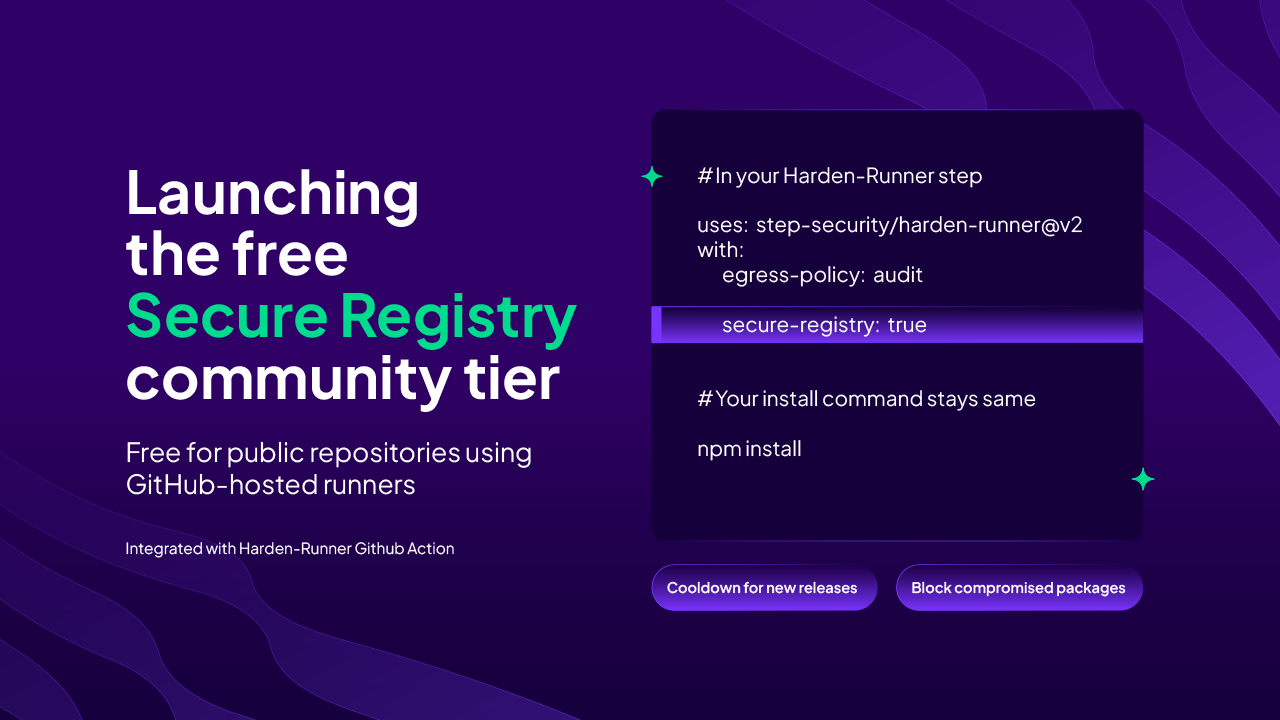
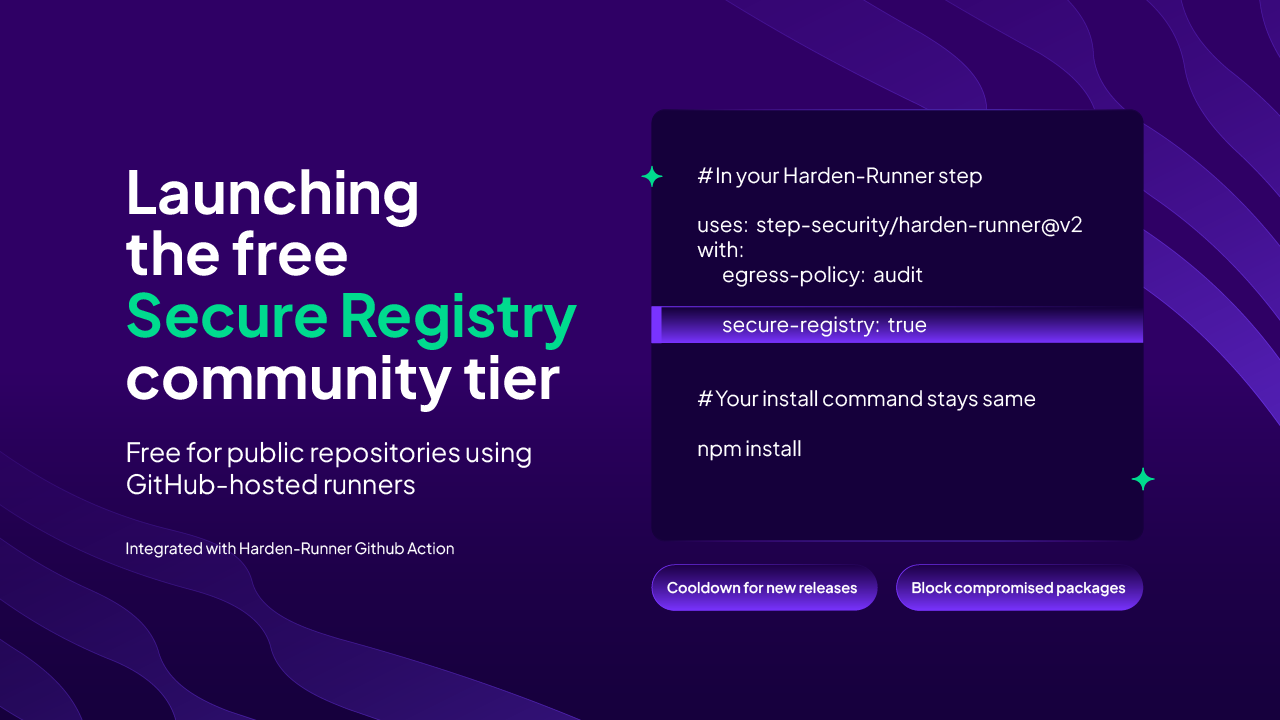
Today, we’re also launching a free Secure Registry community tier, integrated with Harden-Runner. Any public repository using Harden-Runner through the community tier can now pull packages through Secure Registry and apply policies to help block compromised packages. This extends our commitment to making protection accessible to open-source maintainers.
Real attacks shape what we build
Treating every attack as a test case is a literal part of how we build. We simulate real attacks in integration tests and check whether our product detects them. We also ask whether we could have stopped the attack and what would need to change if we could not. Sometimes that means improving a detection. Sometimes it means building protection in a new environment.
Our security research team investigates attacks and helps customers understand whether they were affected. Each investigation gives us another case to test. Even within a single environment, we have to keep improving protection as attackers evolve their methods.
Campaigns such as Shai-Hulud and axios brought malicious dependencies onto developer machines as well as CI/CD runners. Customers needed to know whether developer machines had run those packages or exposed credentials. We built Dev Machine Guard because visibility in CI/CD could not answer that question.
More recent attacks have made the workstation itself an explicit entry point. Tampered Claude Code extensions in Cursor’s marketplace attempted to install persistent SSH backdoors. Binance’s initial findings trace its breach from a malicious interview assignment on an engineer’s work computer through compromised developer tooling to stolen deployment credentials. These attacks reinforce why developer-machine protection is already part of our platform.
Customers also wanted to stop risky packages before they reached a developer machine or build server. That led us to Secure Registry: a control at download time that blocks known compromised versions and holds newly published releases for a configurable cooldown, giving time to uncover malicious behavior before customers install them.
Today, our platform combines developer-machine protection, repository checks, Secure Registry, and Harden-Runner for CI/CD. We believe independent controls at all control points in agentic software pipelines are the strongest defense for agentic software development: a malicious component that gets past one layer can still be detected or blocked at another.
Our growth reflects that expanding need. As we shared in our mid-year update, existing customers were adding products and expanding coverage, often before their first renewal.
AI expands the places that need protection
AI changed three things at once.
- Everyone is now a developer. Any knowledge worker who asks an AI agent for a spreadsheet is pulling open-source packages and executing them.
- Attackers got the same tools. A supply chain attack used to take a skilled team. Now one person can vibe code it.
- Software is built everywhere: by agents on laptops, in the cloud, and inside pipelines, leading to a more complex software supply chain with a larger attack surface.
Security decisions must be enforced where agents act. Package policies need to apply whether a person or an agent requests a dependency; runtime controls need to watch what executes and where it connects. Our existing registry, repository, developer-machine, and CI/CD protections address those risks today.
Customers are asking us to bring Harden-Runner and Dev Machine Guard protections to agent sandboxes. The same malicious package can run on a workstation, a CI/CD runner, or inside an agent sandbox. Protecting one of those environments does not protect the others.
What we will do with this funding
The Series A will help us invest in three areas:
- Product and engineering. Grow our engineering team, deepen our existing products, and extend protection to the environments customers are asking us to secure, including agent sandboxes.
- Security research. Expand our research team’s ability to discover attacks early, investigate their impact, and turn those findings into actionable protection.
- Sales and marketing. Expand our teams to keep pace with growing demand and help more organizations adopt StepSecurity.
We have seen customers adopt one product, find value, and ask us to protect the next part of their development process. This funding gives us the resources to respond faster.
We’re actively hiring
We’re actively hiring across engineering, security research, sales, and marketing. We’re looking for people who want to help protect the places where software gets built and bring that protection to more organizations.
If you want to work on security problems being tested by real attacks, alongside a team whose products are used across open source and enterprise environments, we’d love to meet you.
Thank you
To the open-source maintainers who adopted Harden-Runner early, thank you for giving us the opportunity to earn your trust.
To our customers, thank you for bringing us your hardest problems and helping shape what we build.
To our team, thank you for the care and urgency you bring to this work.
And to Elephant, Runtime Ventures, Inner Loop Capital, and SaaS Ventures, thank you for backing our next chapter.
The next war room may have less time
SolarWinds and Codecov were wake-up calls. Since then, the attacks have become far more frequent. In our August 2026 report, The State of Open Source Supply Chain Attacks, we documented 56 confirmed compromises of trusted software components over the preceding 12 months. By then, the pace had risen from roughly one attack a month in 2024? to one every three days.
A single campaign can also reach thousands of organizations. The report details how Team PCP stole 78,330 secrets from 2,186 organizations during a five-day campaign in March 2026. With self-propagating attacks, such stolen credentials become the means to compromise the next component and reach its users.
We are already seeing early signs of a “Vulnpocalypse”: AI is accelerating attacks, while self-propagating campaigns use stolen credentials to spread across the software supply chain. Coordinated swarms of AI agents will amplify this threat, probing targets, adapting techniques, and spreading in parallel at a pace that overwhelms security teams’ ability to respond. The next generation of attacks will move faster than a war room can assemble. We started StepSecurity because we had lived through the scramble. Today, we help teams defend the places where software gets built. This funding will help us deepen those defenses and evolve them for the attacks of tomorrow.