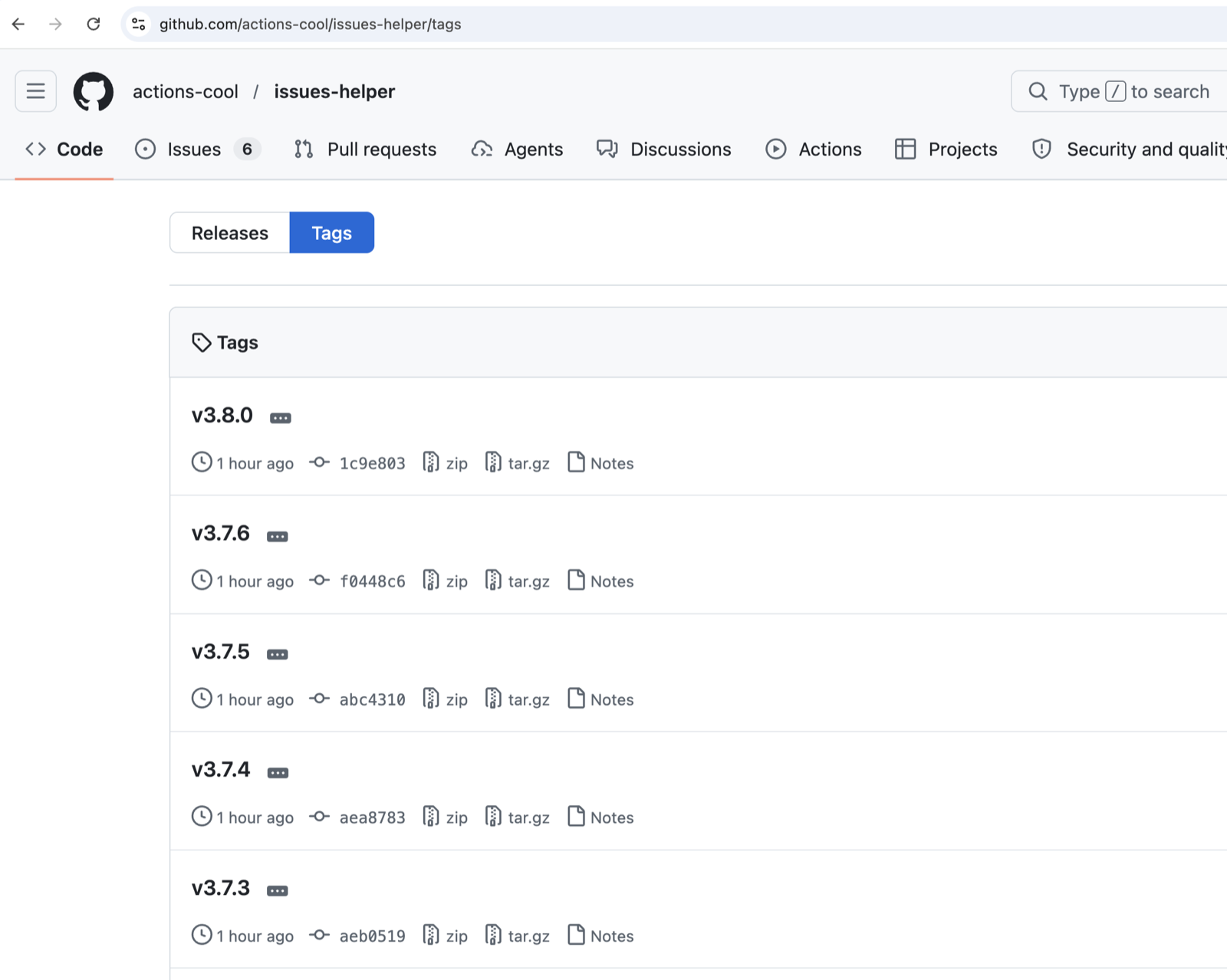
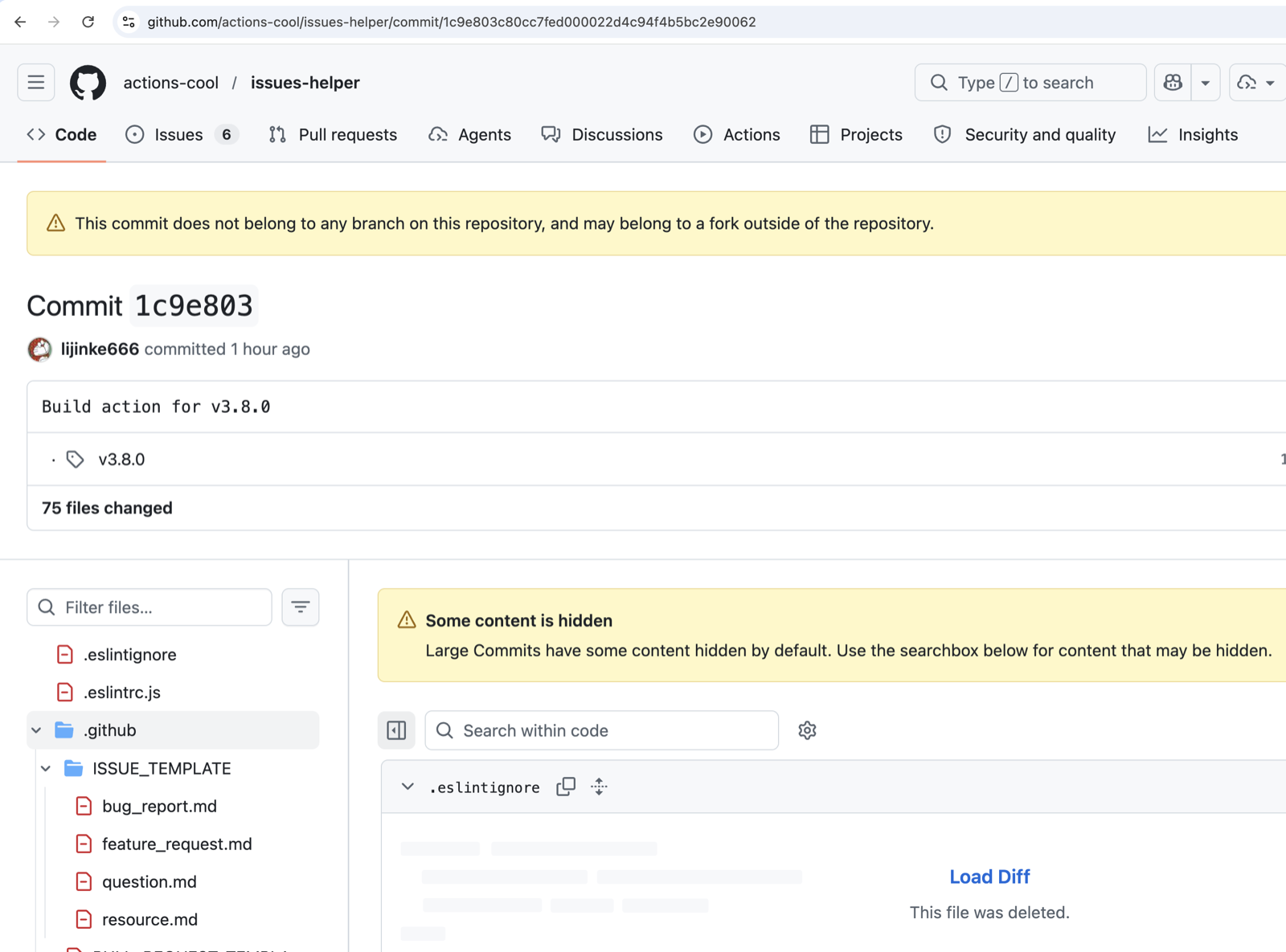
The popular GitHub Action actions-cool/issues-helper has been compromised. Every existing tag in the repository has been moved to point to a imposter commits that does not appear in the action's normal commit history. That commit contains malicious code that exfiltrates credentials from CI/CD pipelines that run the action.
Because every tag now resolves to malicious commits, any workflow that references the action by version pulls the malicious code on its next run. Only workflows pinned to a known-good full commit SHA are unaffected.
A second action in the same organization, actions-cool/maintain-one-comment, has also been compromised by the same actor using the identical pattern - every tag moved to an imposter commit, same bun + Runner.Worker memory-read payload, and the same exfiltration domain t.m-kosche.com. Everything below about detection, IOCs, and remediation applies equally to maintain-one-comment. We have notified the maintainers via GitHub issue #11.
What Happened
- An attacker gained the ability to move tags in the
actions-cool/issues-helperrepository. - All tags were re-pointed to a imposter commits - a commit that is not reachable from the action's default branch history.
- That imposter commit contains malicious code that, when executed inside a GitHub Actions runner:
- Downloads the
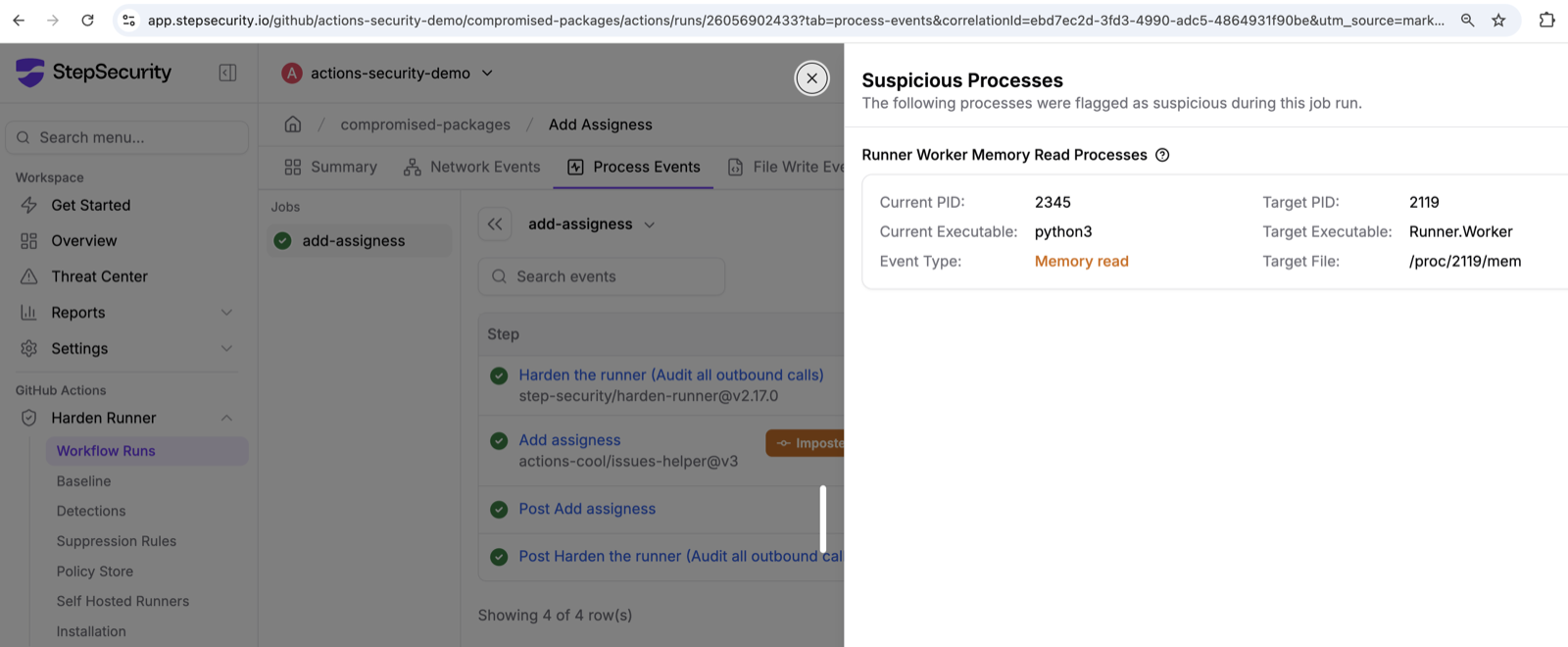
bunJavaScript runtime to the runner. - Reads memory from the Runner.Worker process — the process that holds the workflow's decrypted secrets — to harvest credentials.
- Makes an outbound HTTPS call to an attacker-controlled domain to exfiltrate the stolen data.
- Downloads the
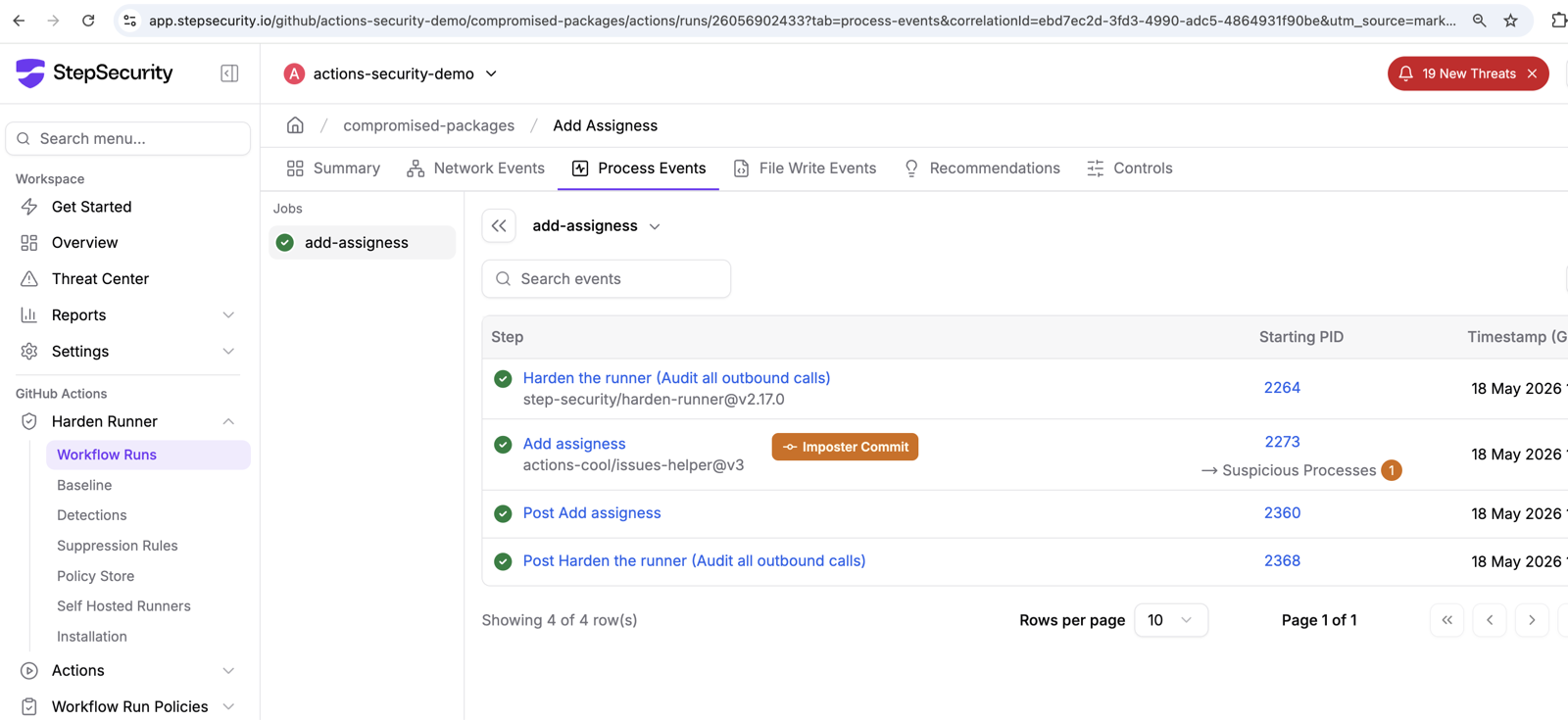
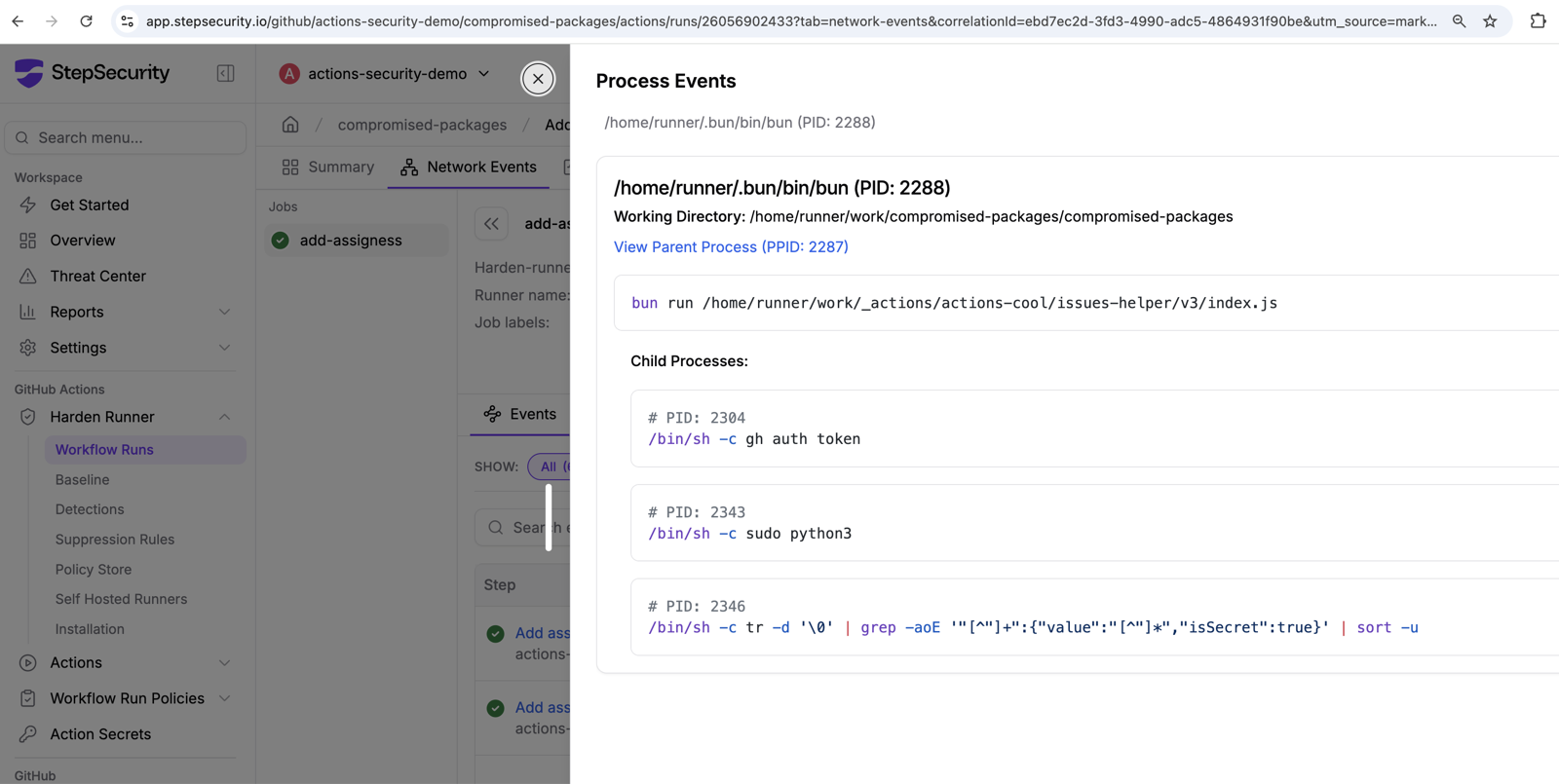
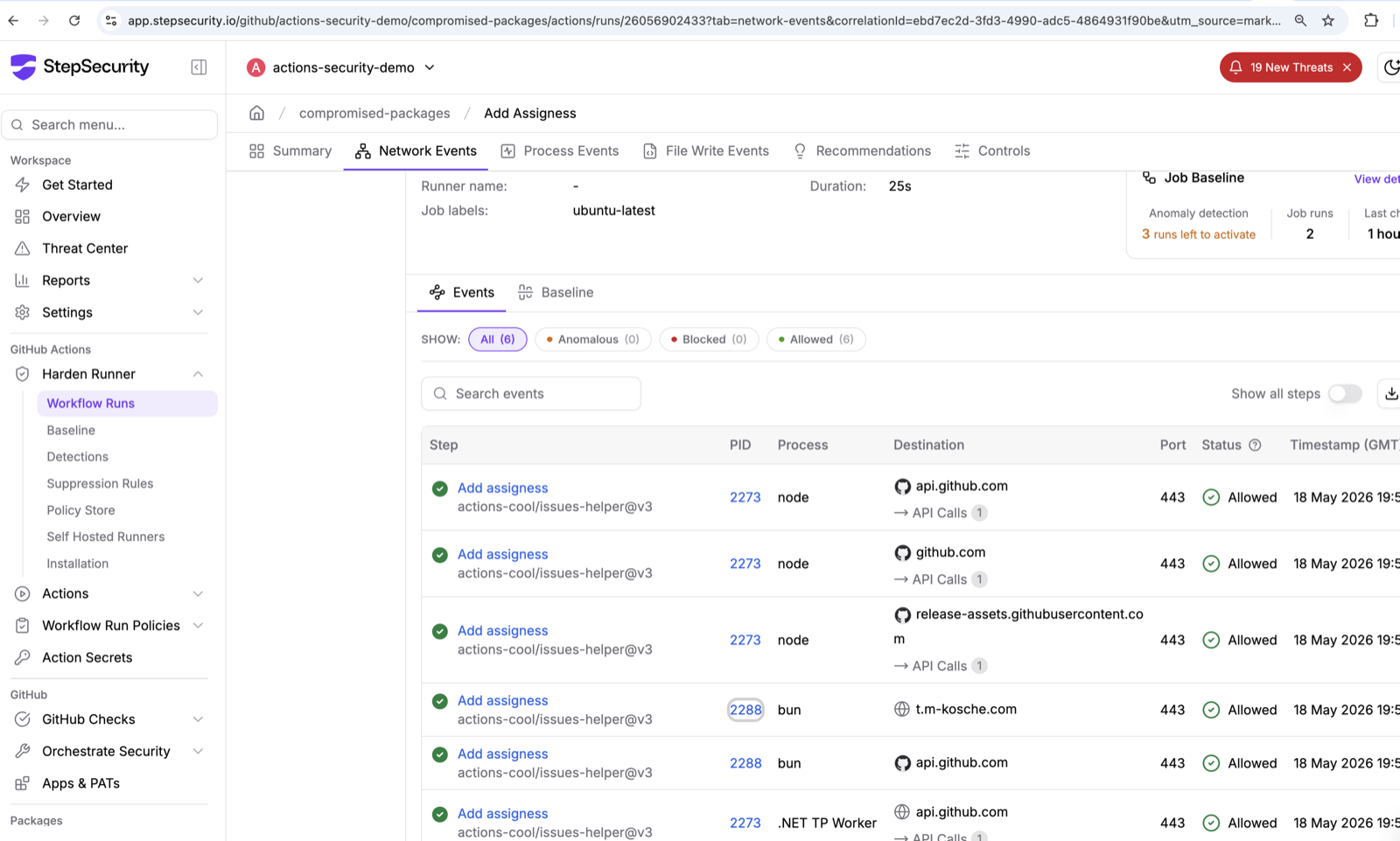
You can see this behavior in a controlled Harden-Runner test run here: https://app.stepsecurity.io/github/actions-security-demo/compromised-packages/actions/runs/26056902433
Harden-Runner captured the bun download, the Runner.Worker memory read, and the outbound call to t.m-kosche.com.
How StepSecurity Is Protecting Customers
1. Compromised Actions Policy — Blocks the Run
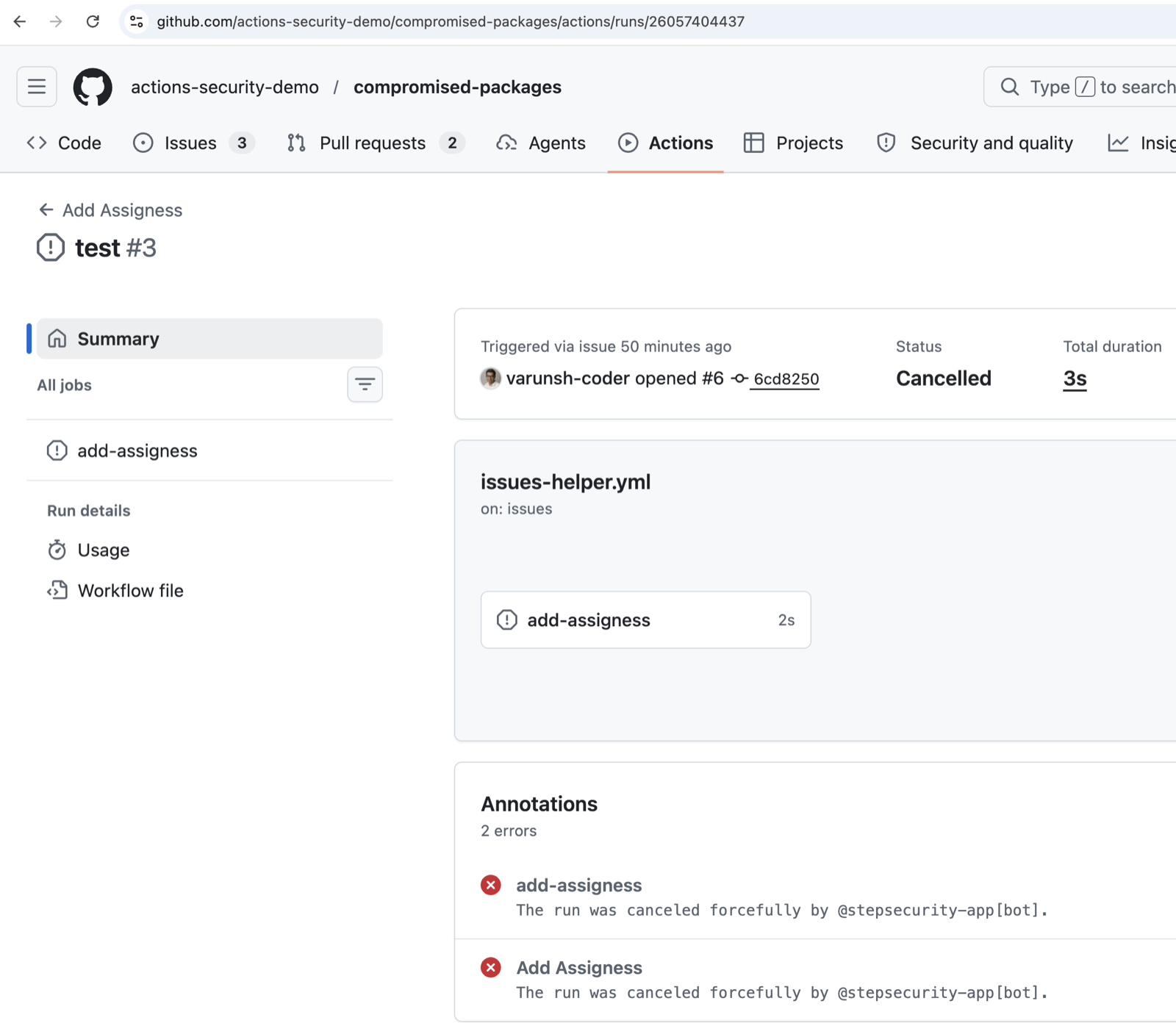
StepSecurity has added actions-cool/issues-helper to its Compromised Actions Policy. For any enterprise customer with this policy enabled, any workflow run that references this action will be blocked before it executes, preventing the malicious code from ever running in the customer's CI/CD environment.
2. Harden-Runner Global Block List — Blocks the Exfiltration
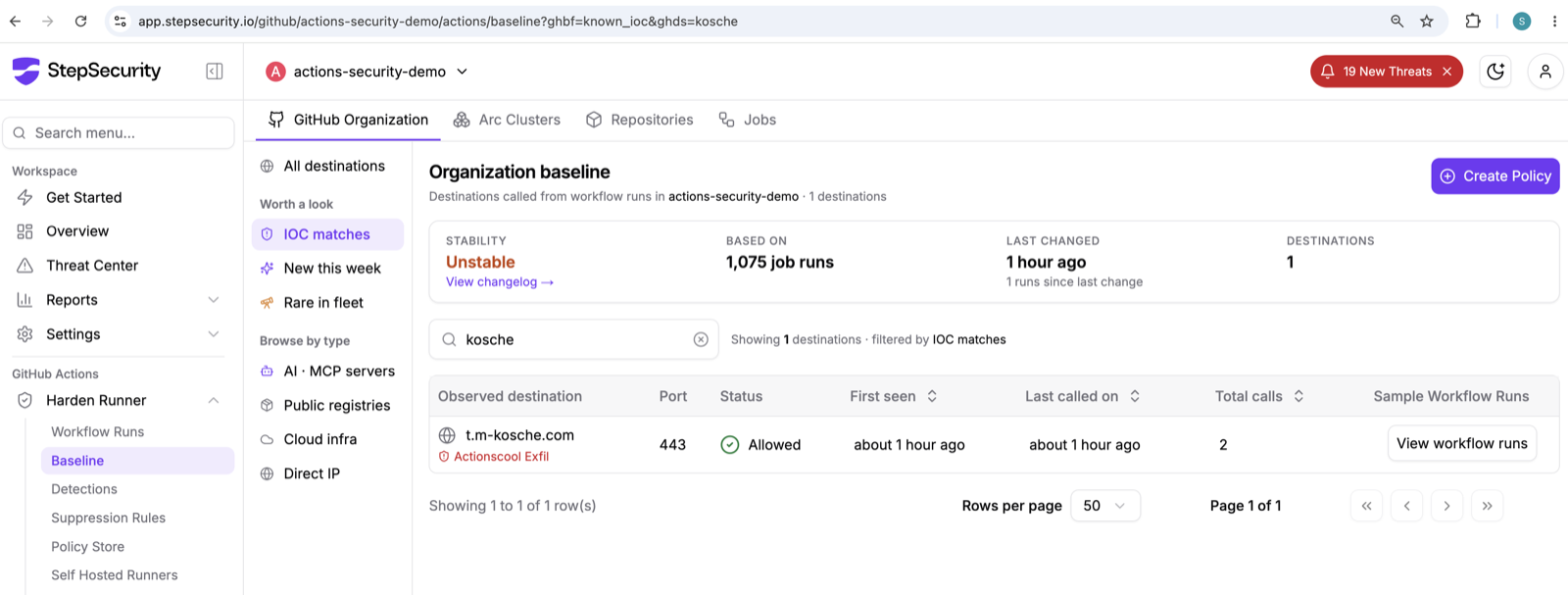
StepSecurity has added the attacker's exfiltration domain to the Harden-Runner global block list. Any workflow protected by Harden-Runner will automatically block outbound connections to this domain - even in audit mode, and without any per-workflow configuration. This gives customers defense-in-depth: even if a compromised action somehow runs, the credentials cannot leave the runner.
3. Imposter Commit Detection
StepSecurity's Action-Uses-Imposter-Commit detection flags any workflow that references a GitHub Action via a commit SHA (or via a tag that has been moved to a commit SHA) which does not match any legitimate tag or branch head of that action's repository - exactly the signature of this attack.
Indicators of Compromise (IOCs)
Affected GitHub Actions
actions-cool/issues-helper— every tag (53 in total) moved to an imposter commitactions-cool/maintain-one-comment— every tag (15 in total) moved to an imposter commit
Exfiltration Domain
t.m-kosche.com— receives the encoded credentials harvested fromRunner.Workermemory. Added to the Harden-Runner global block list.
Payload Markers (on the runner)
- Download of the
bunJavaScript runtime to/home/runner/.bun/bin/bun - Memory reads against
/proc/<Runner.Worker PID>/memfrom apython3child process gh auth token,sudo python3, andtr/greppipelines filtering for"isSecret":true- Outbound HTTPS to
t.m-kosche.comon port 443
Imposter Commits
The attacker generated a unique imposter commit per tag — each with a fake "Build action for vX.Y.Z" message that mirrors the legitimate maintainer's commit-message style. The tells are the timestamps: all 53 imposter commits in issues-helper were created within a 3-minute, 16-second window, and all 15 in maintain-one-comment within 39 seconds. Every commit below is dangling — none are reachable from the action's default branch.
actions-cool/issues-helper — 53 imposter commits (2026-05-18T19:10:24Z → 19:13:40Z):
v3.8.0→1c9e803c80cc7fed000022d4c94f4b5bc2e90062v3.7.6→f0448c62fc57b8a5ce23d8acd6e795cdd76a3b6cv3.7.5→abc4310e6b8520aff6af79a4880217917cd1436bv3.7.4→aea87833045e38098e64310e962b897ae8aaba33v3.7.3→aeb05195dbd618afce6f22ca4937e46940d86be1v3.7.2→4b10341e231301a86c66f6c09e3e4de76d8719fev3.7.1→8a3a7c2960ff3a4e3fd1481cfd1eb31301e16337v3.7.0→aa44b5492c787fbc4c51edb8d98d88b668fe89d1v3.6.3→03bbf452b52fb318196d9c193fd178a79a6d7f9bv3.6.2→257849272e291fb74ff4bee4d3be4796dd35fbbbv3.6.1→4bb72d31eaee87562b70a0cf1b93579bb2b14c23v3.6.0→e0585c10366288eeec3117d65ed24240ccbf1f47v3.5.2→419b34c603623ea8749a98b7153df20e389dd0ecv3.5.1→8cc2629c5681d794c494b79283d23aa3ce78749cv3.5.0→4b69521f9829a1114b94d74fdc1a38f2291d8c34v3.4.0→dc5687b71897e8b57bc9743e325ac72cee763c9cv3.3.3→3846bd4230da36f68a4cc1527298ca9ab2652fb9v3.3.2→459b0cfc4dd708b6218b72a7a01dda6c6a7ab0c0v3.3.1→fa6a4ca487f2dc699d428126ea2b18e9d0d15c9dv3.3.0→15c89f718cd325833aad8000d3ec72e2660f6584v3.2.1→a7d3c46a35564fa85321f3557700f6ea0c0616a9v3.2.0→85c9d842e1c0f41f8805f17600c25237e08a0224v3.1.0→64ed6d61b6eee8744417e1d1cc651665a8bce236v3.0.1→d9b1764cbe78ec9b12f01a66b2d2c902b15981b6v3.0.0→b9c83f01929e190cda300e76f688bf7ea7e37a7av3→147337a919d92f4bf42f02843682d694650f1e22v2.5.0→e9631d2e615d95a19111c272049444fb073a99bev2.4.3→91b26b99c50ad890f98c2184d251bd3a16f5b1b1v2.4.2→3f4d6804812734dfe945bbe8ef619f151e4b27f6v2.4.1→46eff1378ad0faee27c017ebd97f605548777098v2.4.0→071e169dfb36005b3262b3853c9894698b8b303bv2.3.1→55253d49c68133ae52e791a3f1f8242b191f5e91v2.3.0→edf8cf78d6feeb5a73cda9317af5ddfc4da6c5fdv2.2.1→a0c53dd42fc842d2f9276c5a1d4f9a26abe8713dv2.2.0→896379edfaac994ff214a3097c6c82e21be16066v2.1.2→9bd6ce03e0c279f347b519548b87d26699ad31c9v2.1.1→d2877f69bae9d8dcbadb06b3214ebf0789ed566ev2.1.0→601e1296a5a0853b5e109f9820151c72619e11e4v2.0.0→75fb02043af24e6f3eaf534464de338173993629v2→3480e51eec2be03a70d6fe17507413a96fe5b57dv1.12→67716d94ad07d7fe793cabc6f6d1ffe24f77bdf7v1.11→cd96d6518c6338f8510638bce764c7abd7194983v1.10→6a538e928b8856062de61103ed5a08f0ea0faee9v1.9→9793761b1bc3dde7ad1ccb9be6211919e20a3f01v1.8→8a64710bb8fee9f5c92eb1a816e016ed00fbcce0v1.7→710ff89debb143f6859cf8d54c0e8739224ff6c1v1.6→3904fe935f1a18fee5dbad6db46a66c9dcffde01v1.5→cfbd14ccc97afd3baa822bd231df8460e4f02f29v1.4→15dc537110a44b0625622e82b7d6ca95583f276av1.3→e778a401e233bf0a416f3fe2a52d9039949b30a6v1.2→203671479d663755cb5bf8ffbeca6d2b685af7aev1.1→a7156495f3403674cafe3796382bded1d9af8931v1→5c267592a87e92c2b005b338bd0d2724c2f64acb
actions-cool/maintain-one-comment — 15 imposter commits (2026-05-18T19:30:30Z → 19:31:09Z):
v3.3.0→7f6120bb10c870b9fde146961a18e5bf0b3d4401v3.2.1→4a6ac28684e2b0c48d502b31363ec5dd72f9d7ffv3.2.0→f3593fb4454aff5a6e1fb67024f94bfa48591dd5v3.1.1→5d844d6b1c6a0c09a96844521bb01f149d9fe2c1v3.1.0→2ab0aa3449ffe526ea64489193955d82a6848669v3→c43d668894bebbeea688878ab6774fa405f22251v2.0.2→93ec180e89e8fdd8525869daa5590c433b6c30fbv2.0.1→cbb2ba52a811cb6152eee0607519cc5df78289b5v2.0.0→99b7f41bf9e14a2a2c7cc524731336543f552178v2→ef01721dfd04f9c7ff1a256292f7dceabfd08d9bv1.2.1→d6622cc2415156cf4e81cf57866420479a966b3av1.2.0→74b8a9a600daf6fc6070ca0a10d840a7bb6890aev1.1.0→cae76b34894429e693e9b0d2731e7654c373ce81v1.0.0→7bb44528a0869f4074cc5448601804878704963fv0.0.1-wip→8bb68050bc2a353f9d3032e2b42732a69d97499b